The Alpha Model.
Building sustainable partner capability.
Four functional arcs. Nine dimensions.
One System. The Alpha Model.
We know what's limiting your Ecosystem growth because we've built the strategies and run these programs ourselves, out in the field.
What Needs to Be Built
The architecture of a
high-performance partner ecosystem.
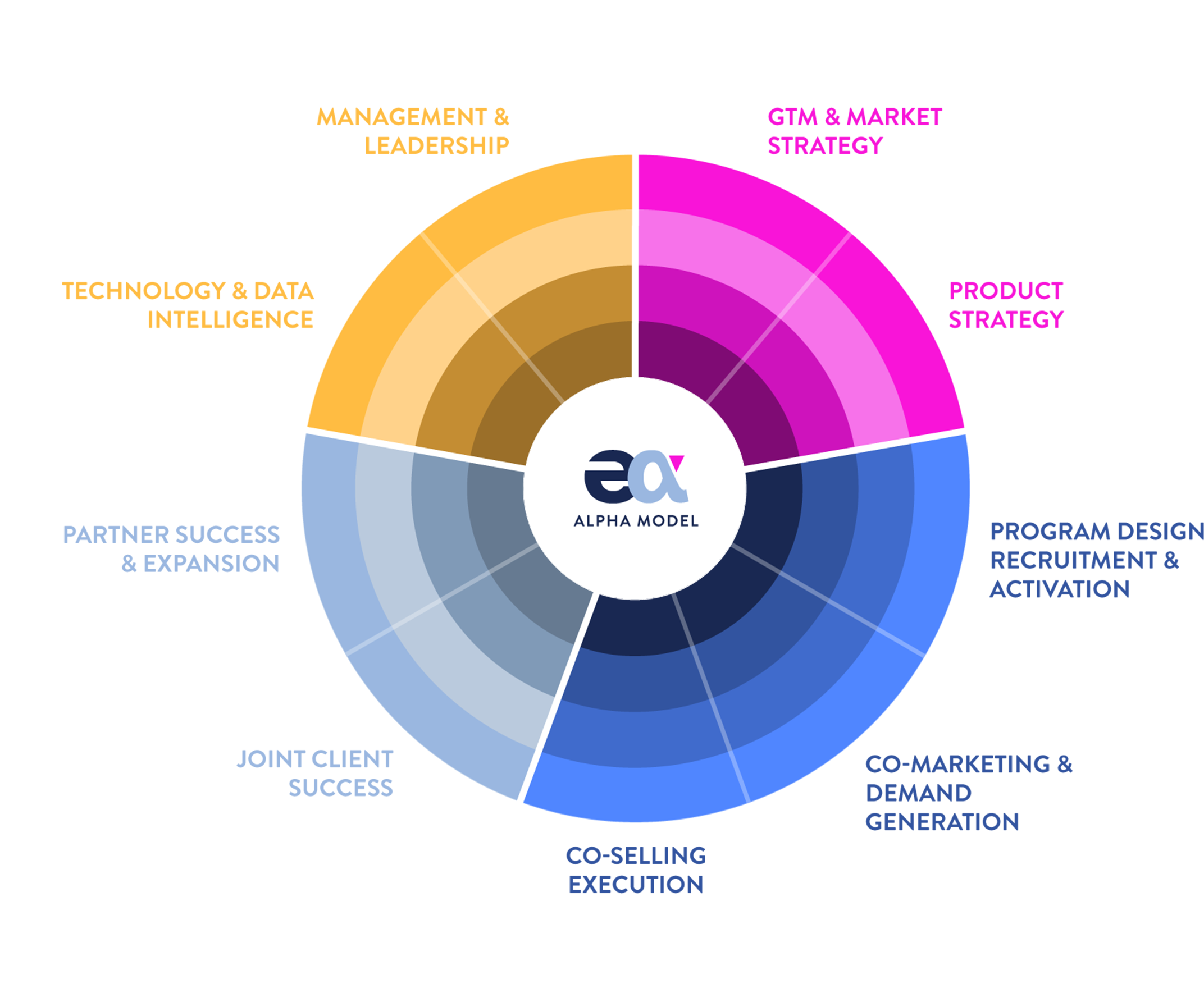
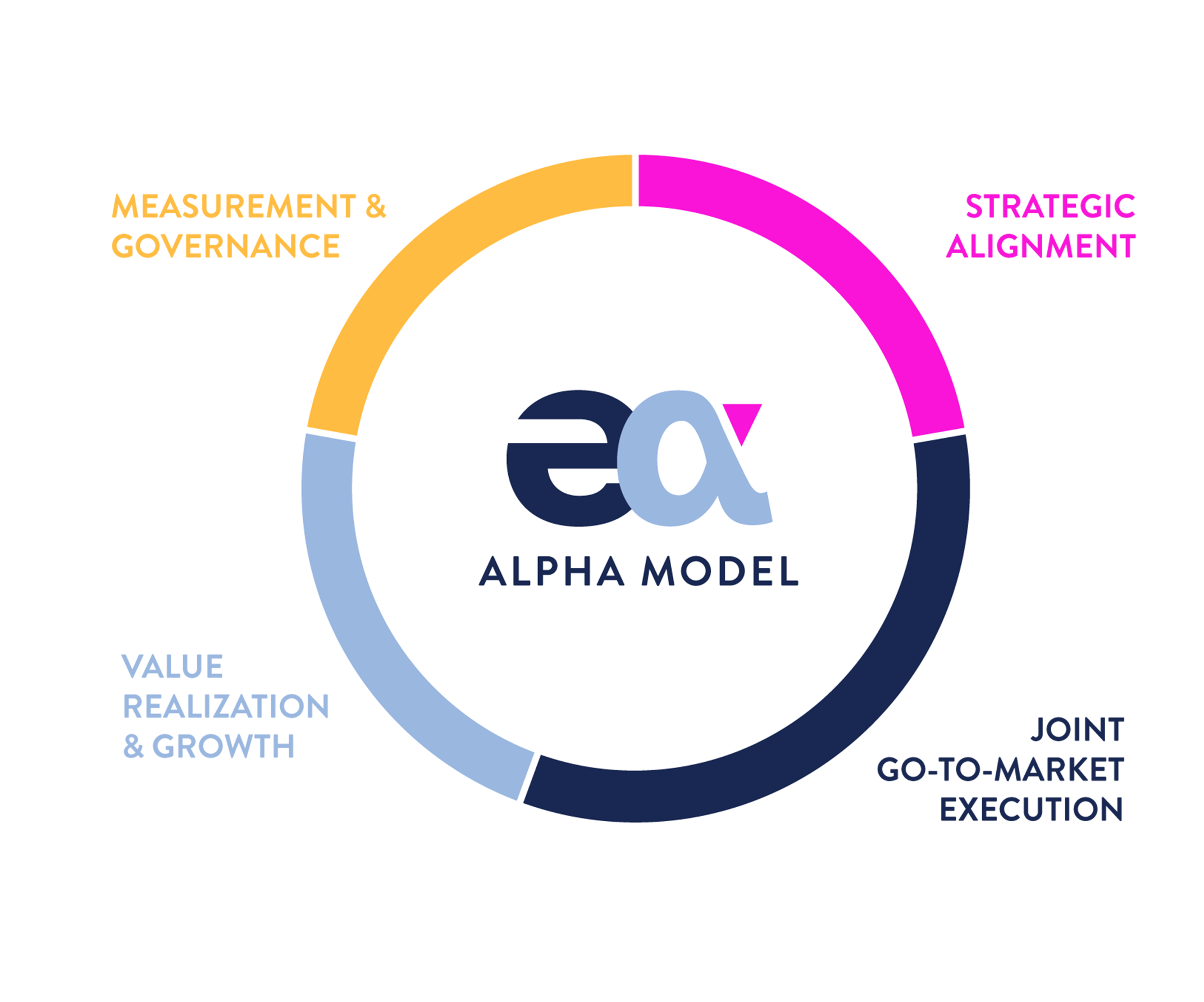
Where the Alpha Maturity Model™ defines where your partner motion sits today, the Alpha Operating Model™ dictates precisely what must be built—and in what order—to scale. The framework connects nine operational dimensions into a self-reinforcing system, where the output of each becomes the input to the next. Rather than isolated workstreams, these dimensions cluster into 4 Functional Arcs of Ecosystem Capability: Strategic Foundation, Joint GTM, Value Realization, and Governance.
ARC I
Strategic Foundation & Alignment
Internal market and product alignment, before any partner arrives.
Dimension 01
GTM & Market Strategy
Defines the overarching joint revenue goals, channel targets, and the Ideal Partner Profile (IPP) tied to the company’s own Ideal Customer Profile. Establishes how the ecosystem motion strategically aligns with and accelerates broader corporate revenue objectives.
Dimension 02
Product Strategy
Evolves the product’s architecture to support seamless, open integrations that create a compelling Better-Together story. Ensures the product is built as a collaborative hub rather than an isolated, closed system.
ARC II
Joint GTM Engine
The outbound motion: finding partners, generating pipeline, closing revenue through them.
Dimension 03
Program Design, Recruitment & Activation
The active execution of identifying, pitching, and onboarding the exact right partners to fulfil the strategy. Focuses on frictionless activation to get new partners to their first revenue milestone quickly.
Dimension 04
Co-Marketing & Demand Generation
Leverages shared audiences, pooled resources, and joint messaging to generate mutual pipeline — shifting the marketing motion from isolated direct effort to ecosystem-led demand generation.
Dimension 05
Co-Selling Execution
The operational process of converting partner relationships into closed-won revenue: sourced lead flow, shared account intelligence, and active joint-pitching, from back-channel support to fully integrated multi-threaded selling.
ARC III
Value Realization & Growth
Protecting and compounding what the GTM engine generates.
Dimension 06
Joint Client Success
Ensures the end-user achieves the ROI they were sold, that combined capabilities are fully realized in delivery, and that the post-sale experience creates the conditions for expansion rather than churn.
Dimension 07
Partner Success & Expansion
Grows the partner’s footprint, tier, and capabilities — partner account management, training, enablement, and tier advancement that turns a signed partner into a compounding revenue asset.
ARC VI
Measurement & Governance
Runs underneath the other three arcs simultaneously.
Dimension 08
Technology & Data Intelligence
Deploys the infrastructure, PRM, and account-mapping tools required to create a single source of truth for the ecosystem — and the multi-touch attribution needed to prove partner-influenced revenue and justify ongoing investment.
Dimension 09
Management & Leadership
Executive steering, cross-functional accountability, shared KPIs, and resource allocation required to scale the partner motion — ensuring the C-suite uses ecosystem data to inform macro business decisions and feed the next cycle.
The Secret of the Flywheel.
The Math Behind Ecosystem Alpha.
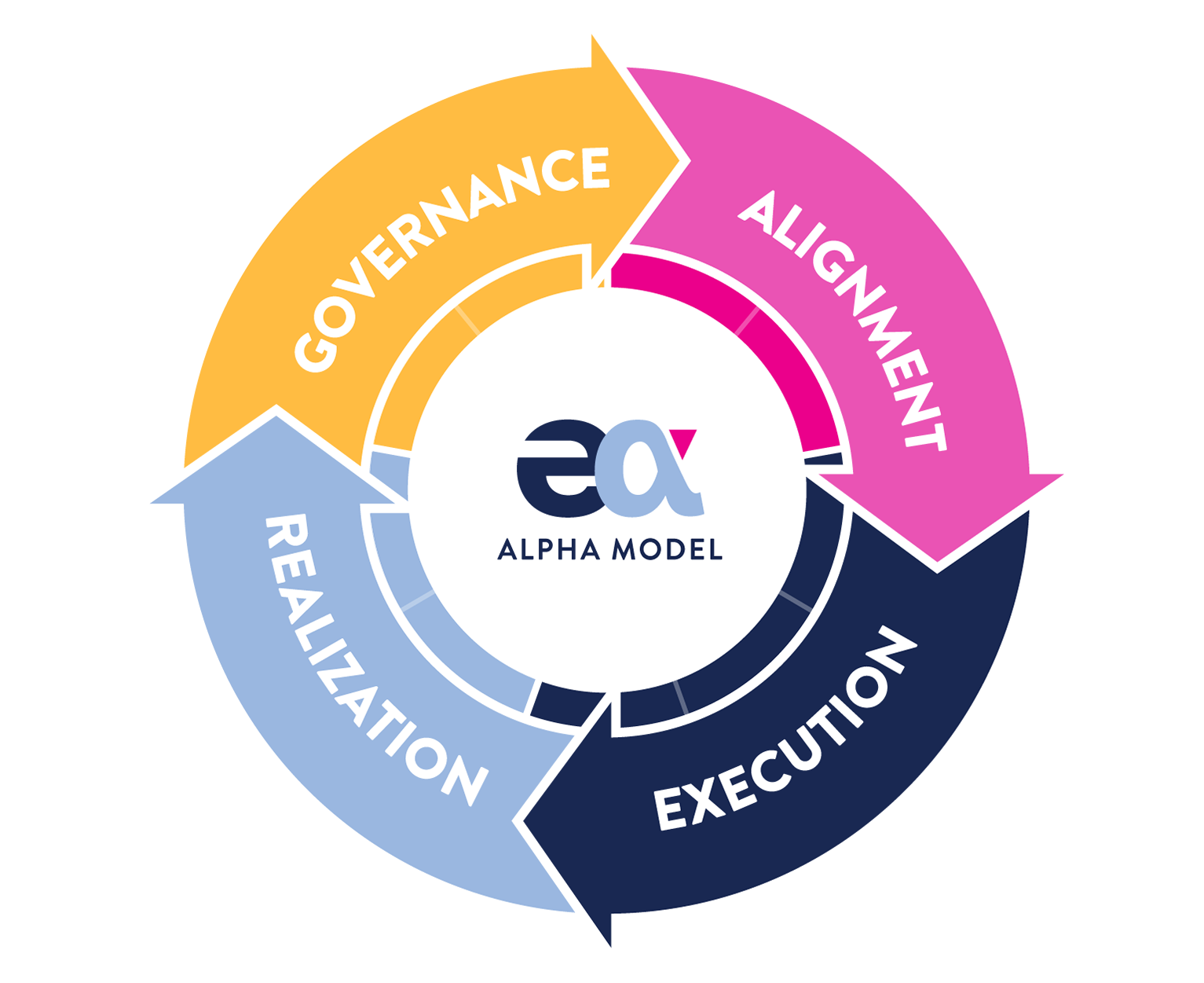
Each rotation makes the next one faster.
The 4 Functional Arcs of Ecosystem Capability unite all nine dimensions into a closed-loop flywheel. By linking strategy, product, GTM, and delivery, the system delivers CFO-ready financial leverage across every executive desk—using governance intelligence to make each rotation faster and more profitable.
Common questions, answered directly.
Is the Alpha Model actually proprietary, or is this a repackaged industry framework?
It’s built from pattern-matching across our own engagements — the stage descriptions, the failure patterns, and the nine dimensions all came from watching the same structural problems recur, not from adapting a published analyst model. It keeps evolving: every engagement is a test of the current version.
Can we see the model applied to our own data, not just in the abstract?
Yes — that’s what the free workshop does. Questions across the nine dimensions, your answers, live placement on the maturity model, and a first pass at which dimensions are the real gap.
Does the model apply outside B2B SaaS?
It was built from and for B2B SaaS partner ecosystems — martech, partnertech, salestech, and data management specifically. The underlying logic (strategy before recruitment, data before governance) likely generalizes, but we haven’t tested it outside that context, so we don’t claim it does.
Do we get to keep the model, or does it stay with Ecosystem Alpha?
Every diagnosis and blueprint built using the Alpha Model is documented and handed to your team. The model itself is how we think; what it produces for your business is yours to run without us.
How is this different from a maturity curve we could find in an analyst report?
An analyst curve tells you which category you’re in. The Alpha Model’s nine dimensions tell you specifically which part of your operating model is broken, why, and what the transition signal to the next stage actually looks like in your own data — that specificity is the difference between a label and a diagnosis.
See the model applied
to your own business.
Reading about the framework only goes so far. The free workshop applies it directly to your program — live, in 90 minutes, using your own data.