Chief Partner Officer Success: Engineering the Mandate for Ecosystem Growth
The data is undeniable: the Chief Partner Officer (CPO) is the fastest-growing title in the C-suite. According to research by Partnership Leaders, the number of these roles has grown over 32% in just this year alone.
However, there is a looming risk for leadership teams: a title alone does not create a Chief Partner Officer; a mandate does. Without a clear charter, the CPO remains “executive branding”—a coordinator with a seat at the table but no plate. And ‘Ecosystems’ becomes a nice to have rather than a must have motion, driving sustainable revenue growth for the organization..
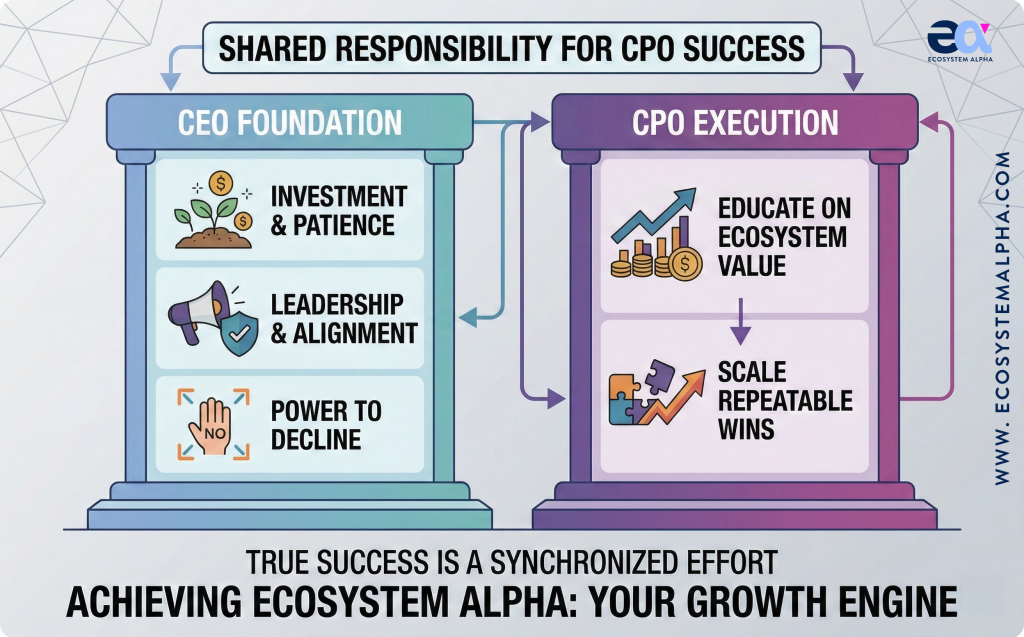
To move the CPO from a symbolic figurehead to a genuine Growth Operator, the mandate cannot simply be handed down or demanded. Creating this mandate is a shared responsibility. The CPO must actively engineer the mandate through education and execution, but they can only do so when the CEO provides the necessary structural support and empowerment.
Part 1: The CEO’s Foundation (Empowering the Mandate)
If you want the “Ecosystem Alpha” that leads to a premium valuation, the CEO must provide the CPO with the runway and authority necessary to build the engine. Whether the role is real or symbolic depends on these uncompromising factors:
- Initial Capital and the “Ramp Period”: A CPO without a budget is a solicitor, but a CEO cannot expect a flawless, fully-baked economic model on day one. The CEO must provide an initial capital runway to give the CPO a “ramp period.” This seed funding allows the CPO to validate early GTM and partnership motions, build foundational infrastructure, and gather the data necessary to develop a robust, long-term roadmap and budget tied to a concrete ROI plan.
- Vocal Leadership and Alignment: Budget and authority are invisible if the rest of the C-suite views partnerships as a secondary priority. The CEO must actively and repeatedly underscore the importance of partnerships for organizational growth. When the CEO publicly champions the ecosystem mandate, it removes internal friction, forces cross-functional alignment, and provides the CPO with the required ‘air cover’ to operate across departments.
- The Power to Decline: Authority means the power to prioritize. If the CPO cannot say no to a distraction or protect their team’s focus, they are reacting, not leading. The CEO must grant them the authority to protect the roadmap and remain focused on high-yield programs and partnerships.
Part 2: The CPO’s Execution (Engineering the Mandate)
The mistake many new CPOs make is waiting for a charter to be handed to them. Supported by the CEO’s foundation, the CPO must own the responsibility to actively engineer their mandate by aligning with the core disciplines of the organization.
- Educate Upward: The C-suite often views partnerships through a narrow lens, such as simply bringing in leads. The CPO’s first responsibility is to educate the board and CEO on the overall value of a thriving ecosystem strategy. They must define the enterprise value impact by demonstrating how ecosystems reduce overall CAC and optimize Return on Invested Capital.
- Expand the Breadth: Equally important, the right CPO doesn’t wait for permission to enter all operational pillars. They start where they have the most traction, gain early wins, and create repeatable success. They then use this data to earn the authority to expand across other revenue-impacting areas of the GTM engine.
Part 3: The Shared Vision: The Four Pillars of the Business Model
Both the CEO and CPO must agree that for partnerships to move the needle, they cannot be a “sidecar” to the GTM strategy. The mandate must empower the CPO to influence the four critical stages of the customer lifecycle:
- Build: Influencing the product roadmap through partner feedback and integrations so the offering is ecosystem-ready.
- Market: Driving joint narratives and co-marketing motions that lower overall CAC and expand reach beyond direct inbound/outbound motions.
- Sell: Moving beyond “referrals” to true co-selling motions that increase Sales Velocity, win rates, and deal size.
- Serve: Leveraging the partner ecosystem to deliver and support the customer, driving long-term success, client retention, NRR, and service margins.
Part 4: Hard-Coding Metrics Across Disciplines
A successful CPO shouldn’t report on the general vanity metrics such as number of partners or new logos. To secure a permanent mandate, the CPO—working closely with CFO and operations—must tie partnership outcomes to the specific revenue generating and Board-level metrics that other leaders live by. By installing Ecosystem as an Operating System, partnerships transform into a predictable revenue engine:
Marketing Efficiency (CMO Alignment)
- Blended CAC: Partners should significantly lower the cost of acquisition by providing warm paths to market and shared marketing spend.
- Lead Quality: Success is measured by whether partner-sourced deals convert faster than cold outbound.
Sales Velocity & Win Rates (CRO Alignment)
- Win Rates: Integrated and co-sold deals typically see a 2x improvement in win rates compared to standalone sales.
- ACV (Average Contract Value): Partner-led, multi-partner solution-sells consistently result in larger, more complex deals.
- Sales Cycle Time: Partners provide “trust equity” and technical validation early in the cycle, which dramatically shortens the time-to-close.
Retention & NRR (CCO/CFO Alignment)
- Churn Reduction: Accounts with deep partner integrations or service involvement often see churn cut by up to 60%.
- Net Revenue Retention (NRR): By turning Customer Success into a high-margin expansion engine through partner services, companies drive durable growth without bloating internal headcount.
Conclusion: A Dual Effort for Ecosystem Alpha
We are moving into an era where the business model is the ecosystem. The surge in titles is a response to this shifting market, but hiring this title alone won’t ensure efficient growth through partnerships.
True success requires a synchronized effort. As a CEO, your job is to move beyond the ‘executive branding’ of the role by providing the budget, authority, and mandate to work across the four pillars. In turn, the CPO must actively build the engine, control that budget, and anchor their success in the mathematical reality of Ecosystem Alpha. When you collaboratively align partner outcomes with core financial metrics, you aren’t just adding a new GTM leader—you are installing a growth engine.
About Ecosystem Alpha
Building the mandate for a Chief Partner Officer is not a solo endeavor; it is a strategic architectural feat that requires the CEO’s empowerment and the CPO’s operational rigor. However, moving from the conceptual What to the execution-ready How is where many organizations stall. This is where we step in. At Ecosystem Alpha, we specialize in helping CEOs and new CPOs bridge the gap between title and impact. Whether you are defining your first ecosystem charter, rewiring your GTM engine for co-selling, or hard-coding partner metrics into your financial model, we provide the frameworks and advisory necessary to turn your ecosystem into a scalable revenue driver. Let us help you install the Ecosystem Alpha model that ensures alignment across you GTM engine, and supports your partner organization in engineering a new era of growth.