The Wisdom Gap: Why the Next Generation of Partner Leaders Needs an Apprentice Model
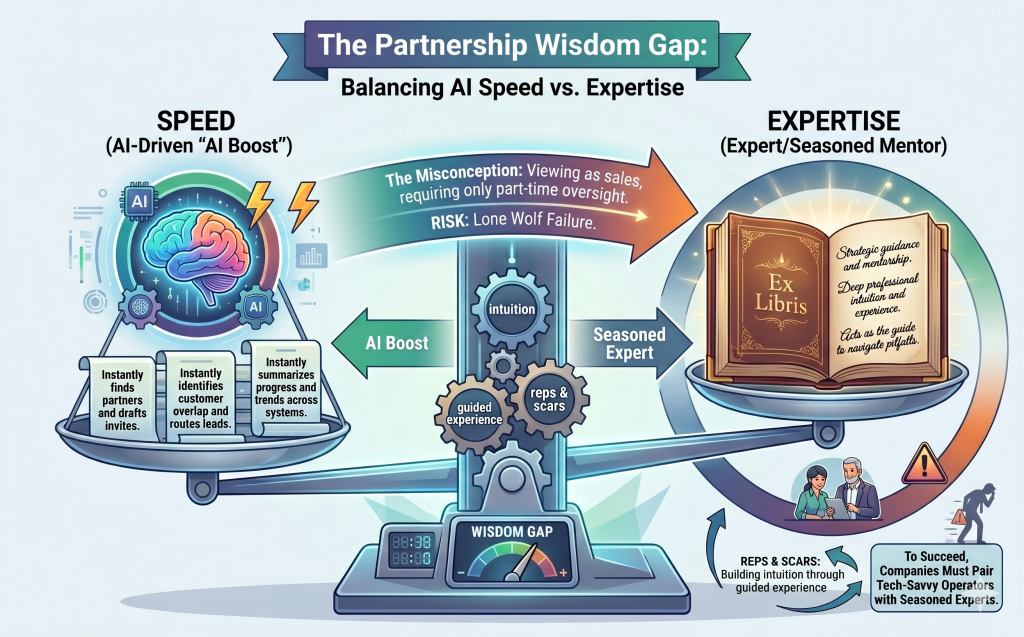
Hiring a partnership “Lone Wolf” is a recipe for failure. AI offers speed, but without wisdom, you’re just crashing into walls faster. Discover why the “Expert and Operator” apprentice model is the only way to turn high-velocity tech into a scalable, experience-driven revenue engine.
In most parts of a growing business, there is a clear “coaching” culture. In Sales, an SDR doesn’t work in a vacuum; they have a manager and seasoned Account Executives to guide their tone and strategy. In Marketing, a junior writer has a Creative Director to refine their message.
But in Partnerships, we consistently see the “Lone Wolf” hire. A company brings in a single person—often a high-potential transfer from Sales or Marketing—and expects them to build a complex ecosystem from scratch. By leaving them on an island without a direct line to experienced wisdom, businesses are creating a massive point of failure.
To build a partnership engine that actually generates revenue, we need to move away from the “solo manager” hire and toward an Expert and Operator structure.
The AI Paradox: Speed Without Direction
The rise of AI has fundamentally changed how we build and maintain partnership motions. Tasks that used to take a human months can now be done in minutes. AI is now shortening the daily lifecycle of partner management across the board:
- Discovery & Outreach: Finding potential partners and drafting personalized invites.
- Account Mapping: Using tools like Crossbeam to instantly identify overlapping customers.
- Lead Routing: Automating the vetting and assignment of referrals.
- Performance Reporting: Summarizing progress and finding trends across disparate data sets instantly.
On the surface, this looks like a win for efficiency. But it creates a dangerous Wisdom Gap. Historically, the “grunt work” of partnerships was the training ground. By manually routing 100 leads, a junior hire subconsciously learned which types of referrals actually close. By building reports by hand, they learned to spot “red flag” metrics before they became disasters.
When AI removes this friction, it also removes the “reps” required to build professional intuition. Think of it like a high-performance vehicle: If you have an operator using AI to move at 100mph, but they don’t have a seasoned expert to help them steer, they simply crash into the wrong walls faster.
Knowledge vs. Wisdom: The Learning Curve
We are fortunate to live in an era with incredible educational resources. Organizations like Partnership Leaders, Pavilion, and Partnership Mastermind offer world-class training. Technology providers like PartnerStack and Crossbeam provide the blueprints and tools to build modern motions.
However, there is a difference between knowledge and wisdom. You can take a course on “Partner Process,” but executing that process in the heat of a high-stakes negotiation is different. Even for a top-tier professional, it typically takes one to two years of on-the-ground experience to truly grasp the nuances of the role. You cannot learn “ecosystem thinking” in a weekend. It takes time to see how a partner’s priorities shift, how to handle “co-opetition,” and how to drive value when you don’t have direct control over the other company’s sales force.
The Missing Middle Management
In a perfect organizational structure, there is a clear ladder: Partner Development Manager → Partner Manager → Director → VP. This hierarchy ensures that at every level, there is someone above you who has “seen the movie before.”
However, because partnership teams are inherently leaner than Sales or Marketing, that middle layer is often missing. Most companies have a “department of one.” Without an experienced management layer to act as a sounding board, the person in the role is forced to guess. They might understand the product and they might know how to prompt an AI, but they lack the experience to answer the high-level questions that a machine cannot:
- The automated report says lead flow is up, but why is the quality of those leads dropping?
- How do I keep a partner engaged after the initial launch excitement fades?
- When a partner’s sales rep steps on our toes, how do I resolve it without burning the bridge?
The Expert <> Operator Structure
To solve this, organizations must rethink how they invest in their people. You need a structure that pairs modern execution with traditional experience.
1. The Operator (The Apprentice)
The Operator is the engine. They are tech-savvy, agile, and capable of using AI and platforms like PartnerStack to handle the manual creation and management of partnership motions. They bring the energy and the ability to execute at scale. But they are an apprentice to the strategy. They need to sit in the room while an expert navigates a conflict or structures a multi-year alliance to understand the “why” behind the “what.”
2. The Expert (The Guide)
The Expert provides the “Wisdom Audit.” Whether this is an internal leader or a dedicated advisor, their job is to sit on top of the technology. They evaluate the output of the AI-driven motions and provide the nuance that a machine—and a newcomer—cannot. They shorten that two-year learning curve by providing real-time feedback on the “unwritten rules” of partnerships.
Conclusion: Investing in the Human Engine
The goal of the Partnership Apprentice model isn’t just to get the work done; it’s to build the next generation of leaders. If we continue to hire people into solo roles without a mentor or an expert structure, we will continue to see partnership programs that stall out because they have “motion” but no “direction.”
When you pair a fast-moving operator with an experienced expert, you stop guessing and start building. You turn a “lone wolf” role into a scalable department, ensuring that the wisdom of the past is used to fuel the technology of the future.
Moving from Operator to Editor
In the AI era, the partnership professional’s job is shifting from “Builder” to “Architect of the Ecosystem Engine.” AI will provide the data and the drafts, but the human must provide the judgment.
By pairing an apprentice with a mentor who has “seen the movie” before, companies de-risk their GTM strategy. You get the high-velocity execution of an apprentice powered by AI, stabilized by the high-fidelity wisdom of a veteran.
The Bottom Line: Don’t hire a lone partner manager and hope they figure it out in a vacuum. Build an apprenticeship that turns technology-driven execution into experience-driven expertise. That is how you build a partner engine that scales.