The Free EA Advisory Workshop
Ask five of your leaders where the partner program stands. You will get five different answers.
That disagreement is where we start. The workshop replaces five opinions with one shared picture of where you are, agreement on where you want partnerships to take the business, and a four-quarter plan with named owners.
90 minutes. No cost. No pitch.
“Partners are under 10% of our revenue.”
Chief Executive Officer“Partners are more than half of our revenue.”
Chief Product Officer“We don't have an established channel or program.”
VP Sales“We're not formally tracking it.”
Strategic partnershipsFour answers, one executive team, one week. The real number: close to half of ARR.
From Where You Are to Where You Want to Go
Multiple leaders, multiple versions of the program.
One road map to where you want to go.
Most leadership teams know partnerships matter and have already felt the friction. What they have not agreed on is what partnerships should do for the business, and how fast. A short survey shows where you are today, the workshop aligns the room on where you want to go, and the readout is the plan to get there.
The survey
Each leader answers privately. We keep the average and the spread, because the distance between the highest and lowest score is usually the more useful number.
2Where you want to goThe workshop
The room agrees where partnerships create the most value for the business, what they have to deliver and how fast.
3How you get thereThe readout
An execution plan across four quarters, with a named owner on every action.
Step 1 · The Five-Stage Lifecycle
Every stage has a definition.
Most teams place themselves one too high.
The map tells you where you are. The nine dimensions tell you how to move. Each stage has one specific gate to clear before the next opens, so the placement is a diagnosis, not a label.
Step 2 · The Nine Dimensions
One picture your leadership
team cannot argue with.
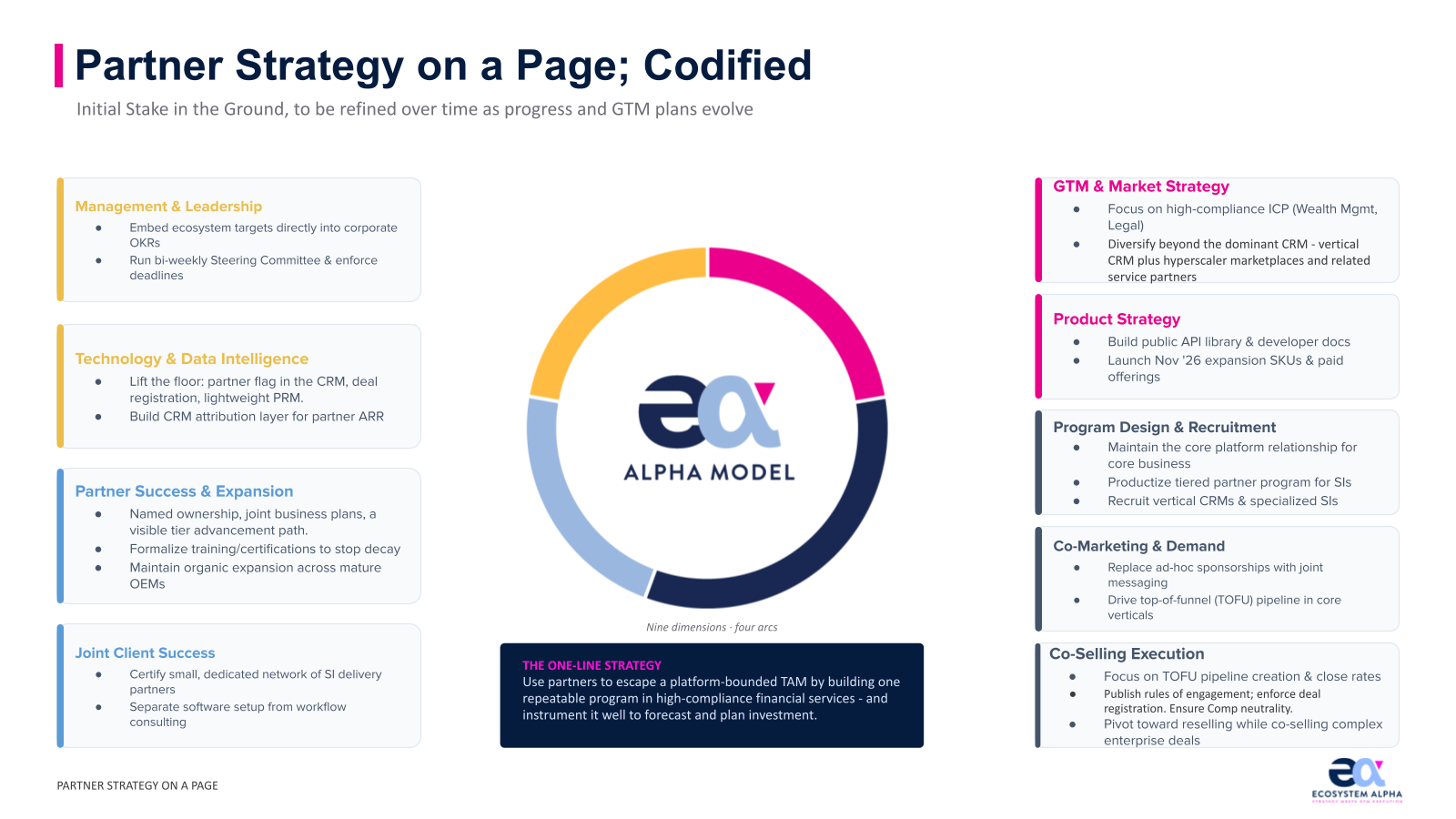
Nine operating dimensions in four arcs that form a closed loop: what gets proven in measurement and governance feeds back into foundation and alignment, so each full cycle leaves the ecosystem sharper than the last. The chart holds the real, anonymised results of a recent workshop.
Segments run clockwise from the top, in the order of the list.
This is the Alpha Maturity Wheel we present to every client. Scoring: 3 of 5 means defined and standardised company-wide. Most companies running partnerships informally land between 1.5 and 2.5. It is a starting line, not a grade. Data: anonymised results of five respondents in a recent workshop.
Step 3 · What You Walk Away With
A readout your CEO can sponsor,
not a deck that sits in a folder
Within days of the session you receive a findings document that carries your own numbers, your team's own words from the room, and a sequenced plan. It is written to be handed to an internal team and executed, with or without us present.
Why partnerships — and what they have to deliver
Your stated objectives, ranked, each mapped to the dimension that owns it.
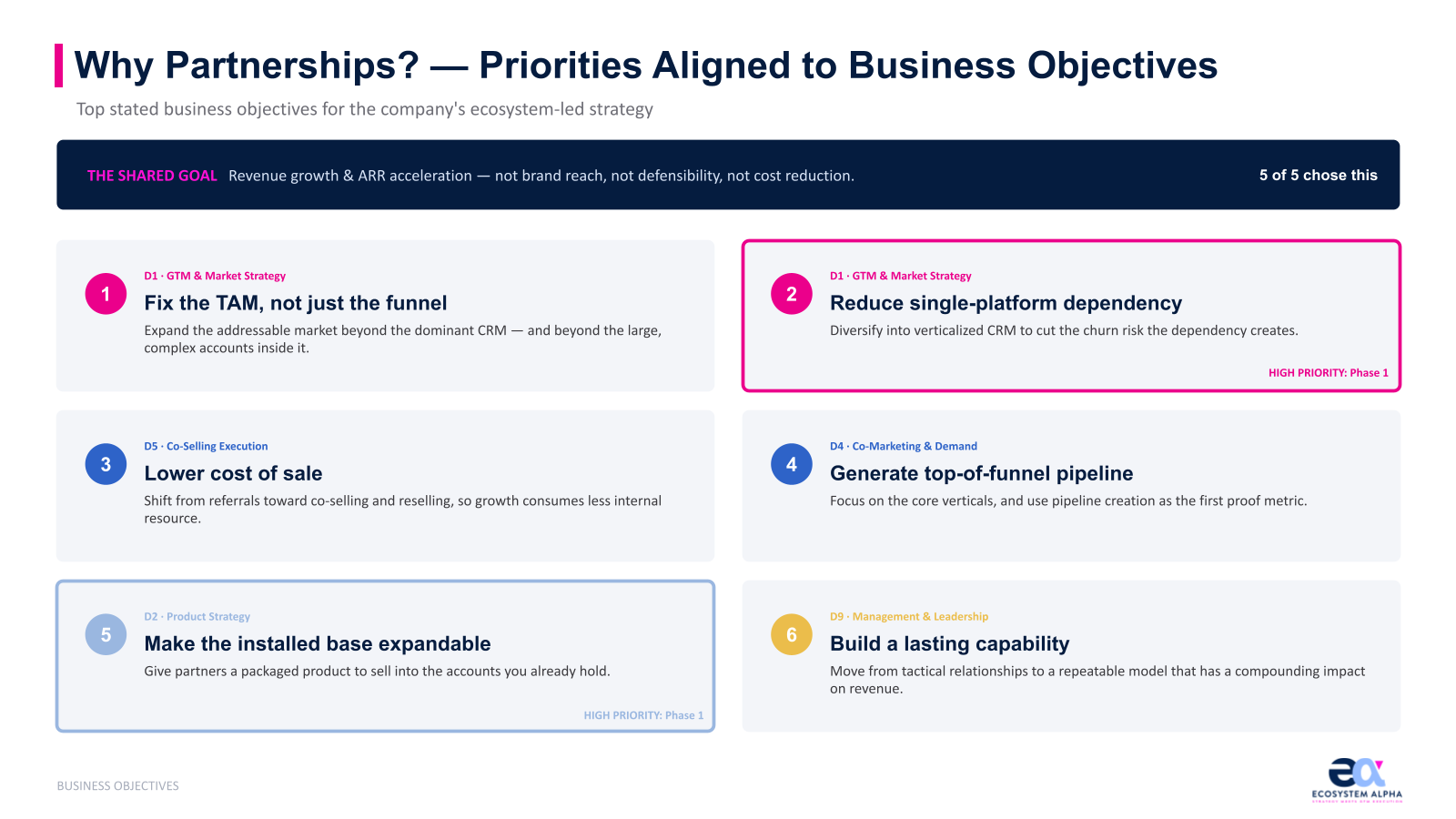
Maturity stage placement
Where you sit, what the room said, and the specific criterion that gates the next stage.
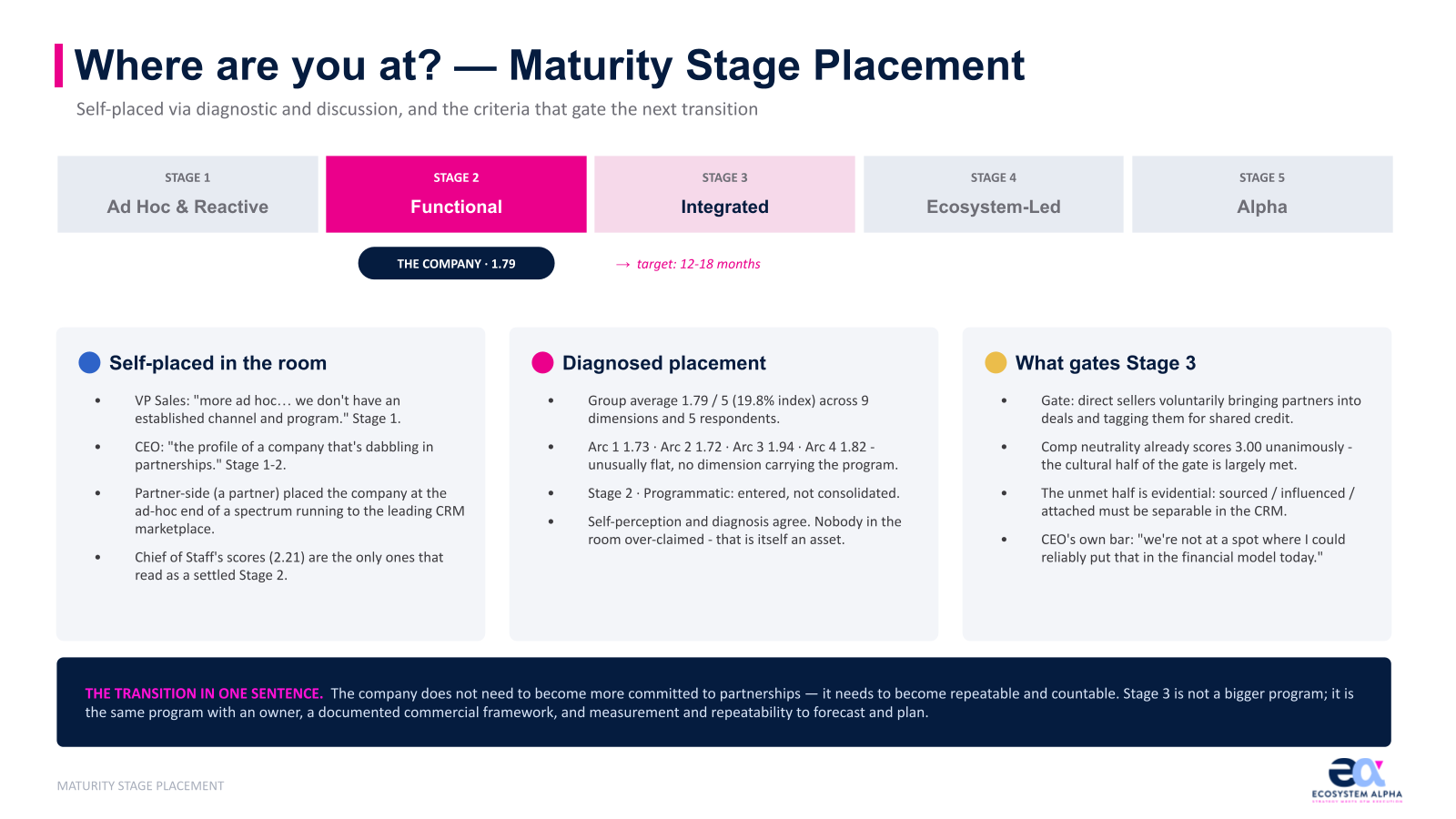
The nine-dimension map
Every dimension assessed against stage, with clear objectives to progress to the next capability level.
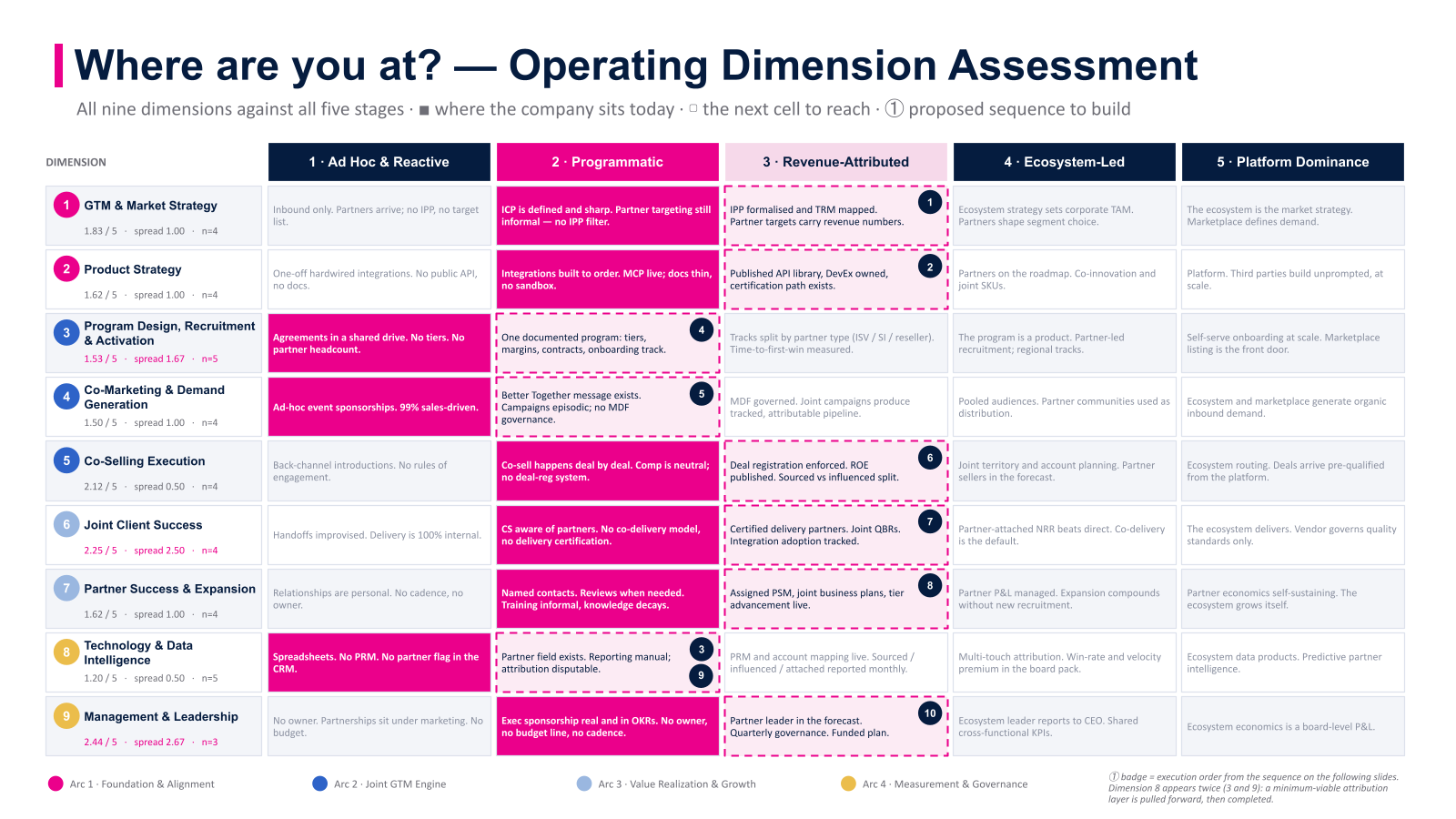
Transformational opportunities
The handful of moves that provide the most impact, each with its dependency and its reason for being in that order.
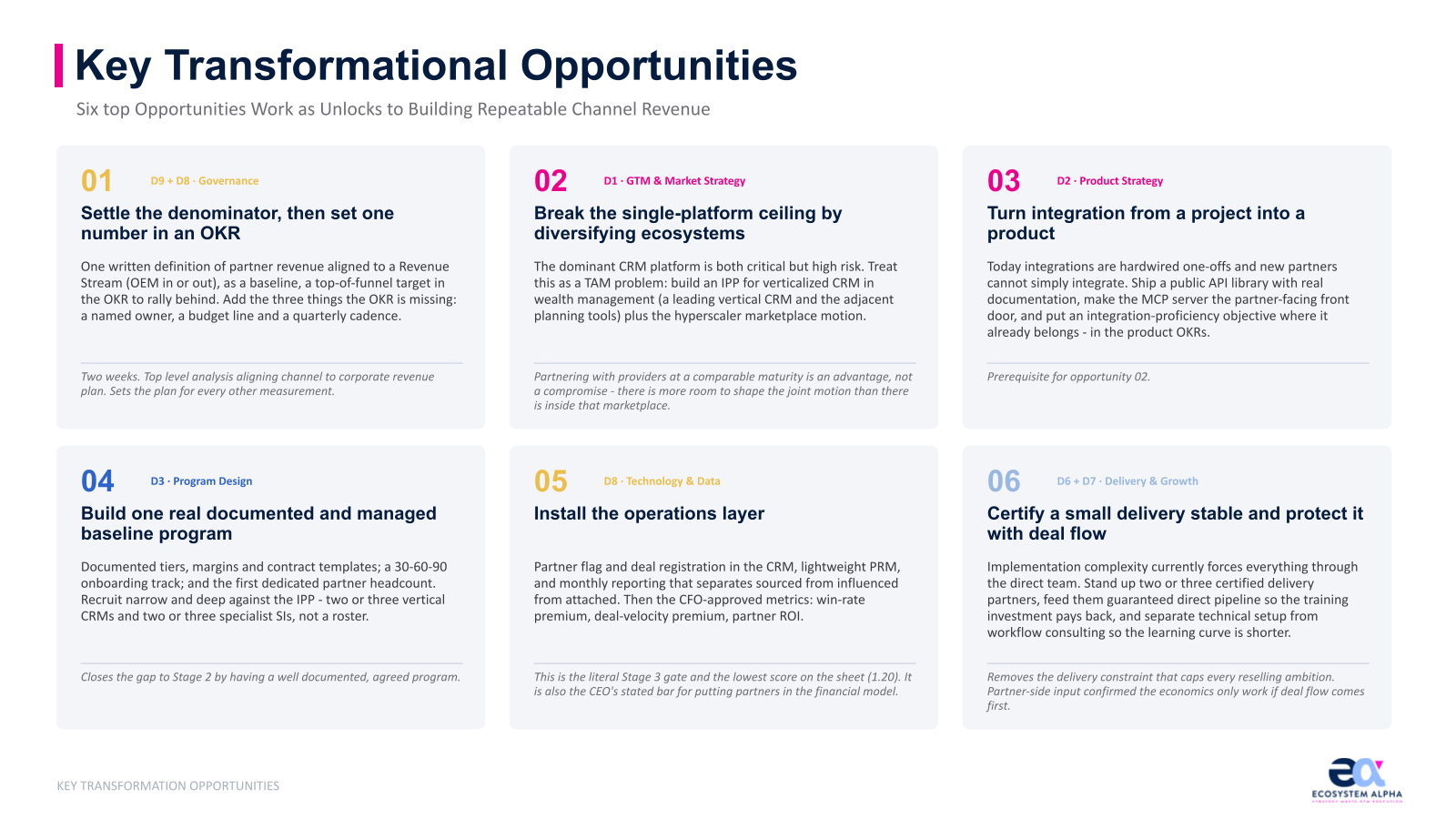
Partner strategy on a page
Codified priorities across all nine dimensions, reviewed quarterly to ensure cross-team alignment.
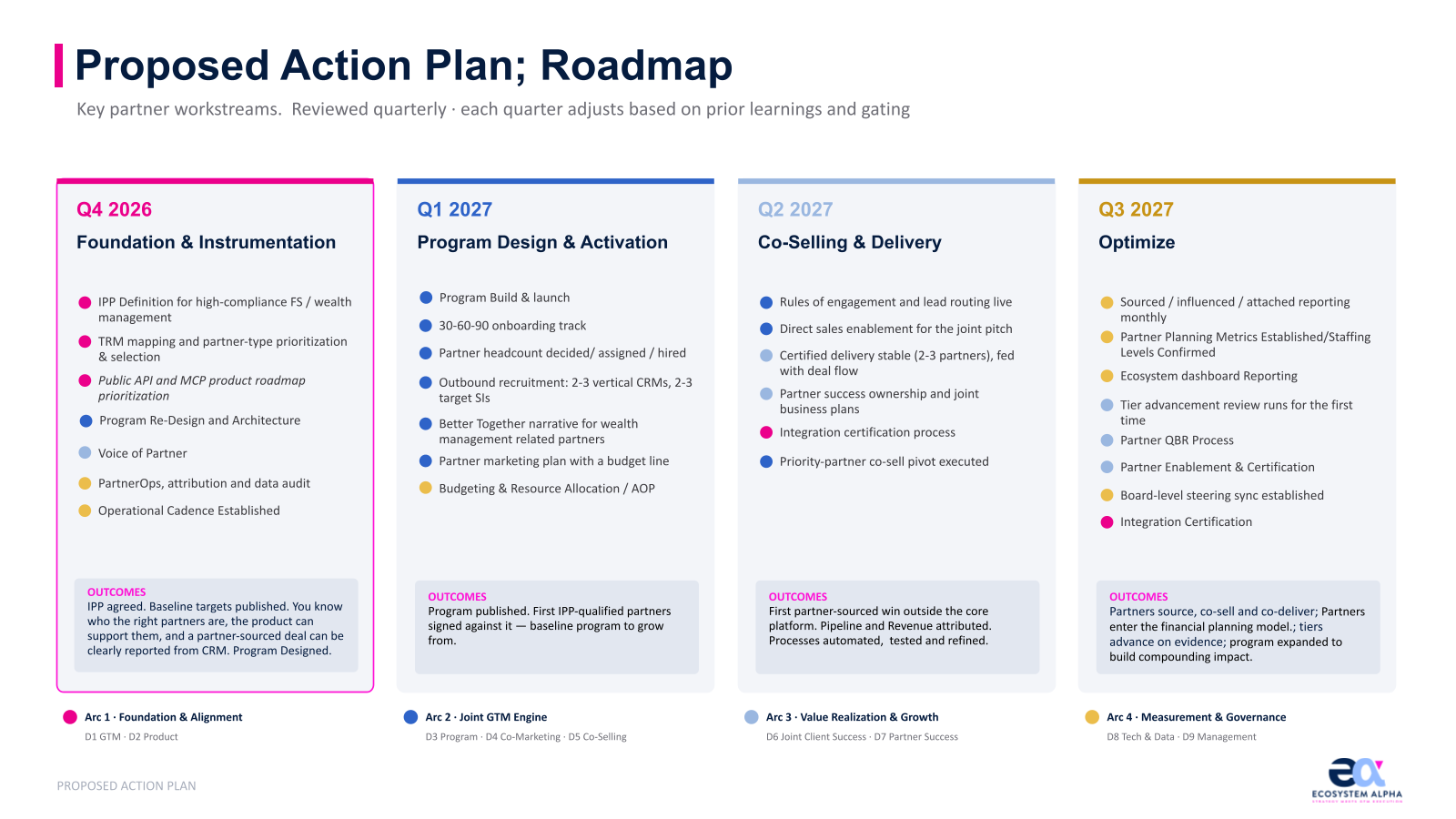
Roadmap and next steps
Who carries what, where alignment is still missing, and the named actions with named owners.
What a Real Session Surfaced
A sales technology company,
five respondents, ninety minutes
Anonymised with the figures intact. The company had executive sponsorship, partnerships already in the company OKRs, and a sales leader who wanted a bigger channel play. What it did not have was a shared account of what already existed.
They were running two partner programs, and only one of them was a program.
Embedded OEM relationships carried roughly half of total ARR with genuinely deep integration — and no owner, no cadence, no marketing spend. The direct-side motion, where every growth expectation sat, had none of the infrastructure the OEM half never needed.
Stage 2 had been earned on results, not on infrastructure.
Nearly half of the prior year's new direct ARR had come through a single partner. The proof that partners drive revenue existed — it just could not be produced on demand.
The blocker was plumbing, not politics.
Compensation neutrality scored 3.00 from every respondent who answered it — the highest agreed score in the diagnostic. Most companies stall in Stage 2 because direct sales fights the channel. This team did not have that fight to win, and plumbing is faster and cheaper to fix than culture.
The largest dependency was also the largest churn driver.
Every direct deal required an integration with one platform, and customers were leaving for that platform's good-enough native capability. A TAM problem before a go-to-market problem — and the structural answer was more ecosystems, not more effort.
Group maturity, out of 5
Stage 2 threshold, entered but not consolidated. Self-perception and diagnosis agreed — nobody in the room over-claimed, which is itself an asset.
Of ARR already partner-borne
Through an OEM channel run by nine people out of a hundred and fifty, growing organically with zero sales or marketing spend.
Want to see what your own session would surface?
Ninety minutes, free, with the same diagnostic and a readout your CFO can read. If it does not make sense for you, we will say so.
What the room decided to do about it
The outcome of that session: a four-quarter plan with a named owner on every action. Each quarter ends with a result that has to be true before the next one starts.
Foundation & instrumentation
- Partner revenue definition and baseline
- Ideal Partner Profile defined
- Partner-type selection and mapping
- Product and API readiness prioritised
- Minimum viable attribution in the CRM
A partner-sourced deal can be reported from the CRM, and you know which partners are worth having.
Program design & activation
- Tiers, margins and contract templates
- 30-60-90 onboarding track
- First dedicated partner headcount
- Narrow outbound recruitment against the IPP
- Joint value story and a marketing budget line
The program is published and the first qualified partners have signed against it.
Co-selling & delivery
- Rules of engagement and lead routing live
- Direct sales enabled on the joint pitch
- Certified delivery partners, fed with deal flow
- Partner ownership and joint business plans
- Integration certification process
First partner-sourced win outside the existing channel, with pipeline and revenue attributed.
Prove the economics
- Sourced, influenced and attached reported monthly
- Win rate and deal velocity against direct
- Ecosystem dashboard reporting
- First tier advancement review
- Board-level steering rhythm
Partner revenue can be forecast with the same confidence as direct revenue.
We don’t have a partner program yet. Is this still for us?
Yes, and often it is more useful. The diagnostic maps what has to exist before a first hire, so the person you eventually hire walks into a defined system rather than a blank page.
What if our partner model doesn’t fit the questions?
Say so in the survey. Embedded OEM and marketplace models in particular do not fit a standard integration framing, and flagging that is a finding in itself. The mapping is configurable and we re-weight it after the session.
What if people don’t answer every question?
Skipped questions are excluded from every average, never counted as a low score. Where someone scored only what sits inside their own remit, the pattern of what they could not see is part of what we show you.
Our scores will be embarrassing.
They will be normal. Most companies running partnerships informally land between 1.5 and 2.5 out of 5, and a flat profile moves faster than a spiked one because there is no internal fight over whose function is the problem.
Who sees the individual answers?
We do, and we present the aggregate. Individual scores come up only where a disagreement is well-evidenced enough to be worth settling, and we name how many people answered before putting any number on screen.
Who should be in the room?
Typically the CEO, CRO, CMO and whoever owns partnerships today. If nobody owns it yet, the CEO and CRO directly. We ask for the people who answer for revenue, not a delegate.
Is there any commitment?
No. No sales deck, no product demo, and no homework beyond a 15-minute survey. If the workshop does not fit, we say so on the intro call.
How long until we have the readout?
Within days of the session. It carries your diagnostic results, the decisions made in the room, and the four-quarter plan with owners.