The Agentic Transition: How C-Level SaaS Executives Can Survive the AI Repricing
By Sebastian Hoelzl,
The Agentic Transition shifts value from human augmentation to autonomous execution, killing the “per-seat” metric. To survive, SaaS leaders must move beyond AI bolt-ons to agent-native architectures that monetize tangible outcomes over mere access.
We have officially entered a structural paradigm shift in the enterprise software ecosystem. For the past two decades, SaaS valuations were built on a simple, predictable metric: the human seat. The more employees a company hired, the more software licenses they bought. Today, that mathematical certainty is collapsing.
The transition from generative AI (tools that augment humans) to agentic AI (autonomous systems that execute multi-step workflows without human intervention) is fundamentally rewiring how software delivers economic value. By 2030, the global application software market is projected to expand to $780 billion, and AI agents are expected to capture over 60% of that total profit pool.
However, this massive wealth creation will not be distributed evenly. For C-level executives in the MarTech, SalesTech, PartnerTech, and Data Management spaces, the era of “observable proof” is here. The market no longer rewards software companies for simply bolting AI chatbots onto legacy platforms. You must definitively prove that your AI creates net-new value, or you will quickly find your software relegated to an infrastructural cost line.
Here is an outline of what these market learnings mean, the consequences you should expect across specific SaaS sectors, and the strategic playbook for managing this transition.
What the Learnings Mean: The Era of Seat Compression
The most urgent threat to the traditional SaaS business model is a deflationary phenomenon known as “seat compression”. When a single AI agent can perform the administrative, analytical, or operational tasks of ten junior employees, the enterprise requires drastically fewer human workers. Consequently, they require significantly fewer individual software licenses.
This is not a future hypothesis; it is happening right now. We are seeing major legacy SaaS platforms experience historic valuation pullbacks and unprecedented declines in enterprise seat counts as autonomous agents natively take over ticketing, data entry, and project management.
Furthermore, agentic AI is causing severe “moat erosion.” Traditional SaaS vendors built defensive moats through application lock-in and complex user interfaces. But AI agents bypass the human interface entirely, extracting and migrating data across platforms via APIs. Consider the recent operational pivot by Klarna, which consolidated 1,200 disparate SaaS applications into a unified, in-house knowledge graph to power its AI agents. Klarna did not eliminate software; they de-bloated it, proving that fragmented point-solutions are highly vulnerable to being bundled away.
Consequences to Expect by Industry
The impacts of this shift are highly asymmetric. Depending on your vertical, agentic AI is either an existential threat to your pricing model or the greatest expansion opportunity in your company’s history.
| Industry | Disruption Risk | Primary Consequence | Strategic Imperative |
| MarTech | Severe | Commoditization of content creation; seat compression eliminates traditional per-user marketing models. | Pivot from workflow automation to “Context-as-a-Service” driving AI-fueled brand loyalty. |
| SalesTech | High | AI agents automate CRM data entry, lead scoring, and outbound prospecting, shrinking entry-level sales headcount. | Evolve into “human-guided AI” where agents handle volume and humans focus on complex relationships. |
| PartnerTech | Moderate | Shift from static partner portals to dynamic ecosystems managed by autonomous AI partner assistants. | Scale channel marketing and turn Market Development Funds (MDF) into measurable pipeline. |
| Data Management | Beneficiary | Fragmented SaaS data causes AI hallucinations; massive demand for unified, pristine data architectures. | Build the “Corporate Brain” securing data clean rooms and autonomous ETL pipelines. |
How to Manage the Shift
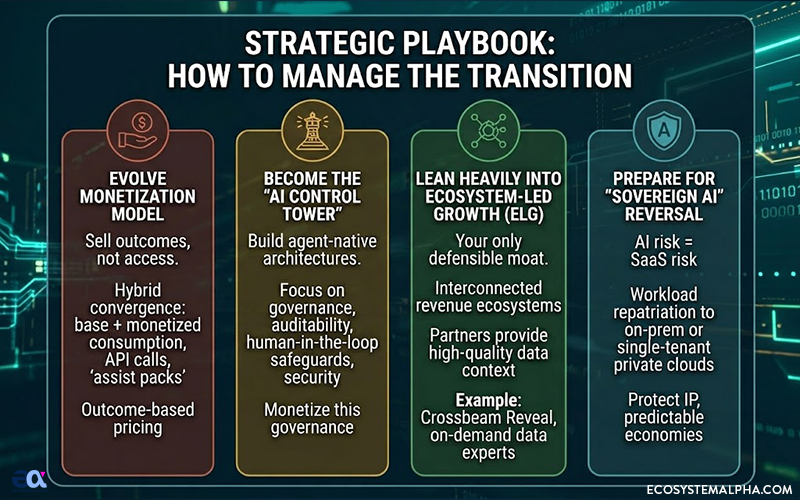
To survive the agentic transition, SaaS leaders must abandon the legacy playbooks that got them to this point. Overcoming seat compression requires a complete rethink of your architecture, your pricing, and your go-to-market strategy.
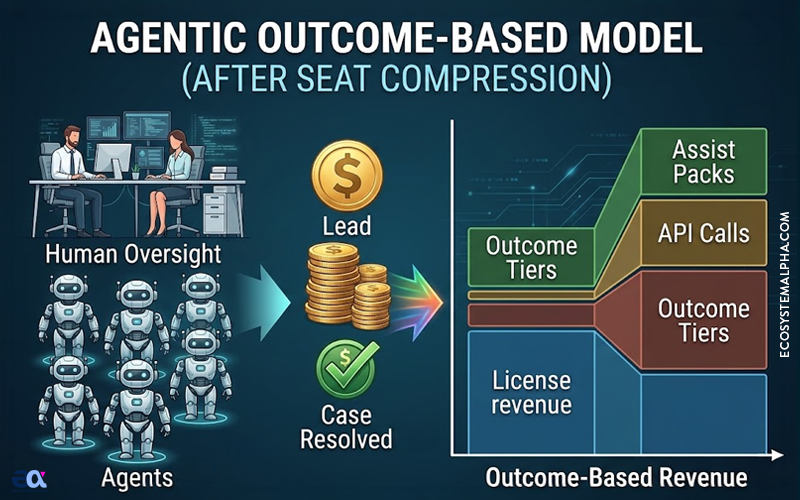
1. Evolve Your Monetization Model You can no longer sell access; you must sell outcomes. Because AI agents replace the human seats that traditionally drove revenue, maintaining a strict per-user pricing model will destroy your margins. Companies must transition toward hybrid convergence models: maintaining a base platform subscription while heavily monetizing consumption-based tiers, API calls, or “assist packs” for AI actions. The ultimate destination is outcome-based pricing, where vendors charge a premium only when a specific task—like a resolved ticket or a qualified lead—is successfully completed by the agent.
2. Become the “AI Control Tower” Stop building user interfaces solely for human operators. Your new mandate is to build “agent-native architectures” that other AI systems can seamlessly interact with. More importantly, as autonomous agents take over sensitive workflows, the risk of silent operational failure skyrockets. You can capture massive value by pivoting your platform into an “AI Control Tower“—monetizing the governance, auditability, human-in-the-loop safeguards, and security of these agents.
3. Lean Heavily into Ecosystem-Led Growth (ELG) As the founder of Ecosystem Alpha, I see this as the most critical survival mechanism for the next decade. If AI commoditizes your baseline features, your partner ecosystem becomes your only truly defensible moat. AI agents require precise, high-quality context to function reliably. By securely integrating second-party data from your partner networks, your platform can provide the exact intelligence these autonomous agents need to execute campaigns and sales outreach effectively. We must move away from closed walled gardens. The future belongs to interconnected revenue ecosystems where AI tools like Crossbeam Reveal act as on-demand “data experts,” instantly querying overlapping partner populations to turn hidden ecosystem data into actionable pipeline,.
4. Prepare for the “Sovereign AI” Infrastructure Reversal Finally, understand that AI risk has become inextricably linked with SaaS risk. Because AI agents can rapidly access and process highly sensitive corporate data, enterprise IT teams are becoming incredibly wary of public SaaS sprawl. We are witnessing a massive architectural reversal where organizations are actively repatriating specific workloads back to on-premises environments or single-tenant private clouds to build “Sovereign AI“. If you are a Data Management or SaaS provider, you must be prepared to offer secure, localized deployment options that guarantee intellectual property protection and predictable inference economics.
| Operational Metric | The Legacy SaaS Era | The Agentic AI Era |
| Core Value Proxy | Human employee access (Seats) | Tangible business results (Outcomes) |
| Product Architecture | Destination interfaces for humans | API-first orchestration hubs for agents |
| Growth Strategy | Linear outbound selling | Ecosystem-Led Growth (ELG) and co-selling |
| Data Environment | Fragmented, proprietary silos | Unified data fabrics and knowledge graphs |
The mandate for the C-suite is clear. The future of enterprise software is not an application to be manually operated; it is an autonomous infrastructure to be governed and secured. Those who embrace ecosystem-led strategies and align their pricing with real-world outcomes will capture the lion’s share of this $780 billion expansion.