The Executive Guide to Building a Scalable Partner Program: The Goldilocks Paradigm
For a CEO or GTM leader, a partner program is often viewed through two lenses: either a nice-to-have source of incremental leads or a complex legal headache that’s hard to measure.
The reality is that a high-performing partnership ecosystem is a force multiplier. To build one that scales without increasing your overhead, you must move past random acts of partnering and adopt the Goldilocks Paradigm. This guide explains how to build a program that is structured enough to scale, but flexible enough to win.
The Strategic Pre-requisite – Ecosystem Mapping
Before designing agreements or tiers, we must perform an Ecosystem Mapping exercise. We do not build a program for everyone; we build it for the specific entities that already touch our target customer.
This pre-step identifies the “who” and “where” of our potential influence:
- Identify the Surface Area: Where does our customer spend money before, during, and after they buy from us?
- Target Partner Profiling: We define the ideal partner profile (IPP) based on their technical capability, market reach, and incentive alignment.
- Relevance Filter: We prioritize partners who solve a specific gap in our current GTM motion—whether that is geographical reach, technical integration, or industry-specific trust.
This guide assumes this mapping is performed in conjunction with the program design below to ensure the programs we build actually have our target participants ready to fill it.
1. The Strategy: Avoiding the Two Extremes
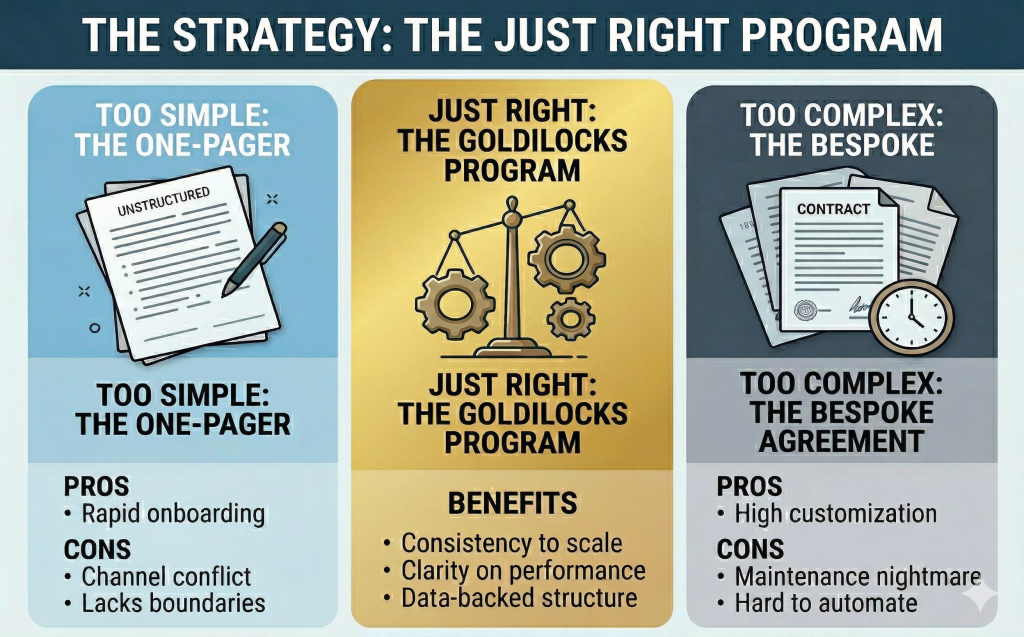
In partnership design, there are two danger zones that kill GTM momentum. Success lies in the middle.
The ‘Too Simple’ Approach: The One-Pager
This is the low-friction model. It’s a simple, one-page agreement that allows anyone to sign up and start referring business in minutes.
- The Pros: Rapid onboarding and limited barrier to entry.
- The Cons: It lacks boundaries. Without clear guidelines on operating procedures, brand usage, or lead ownership, you risk massive confusion and ‘channel conflict’ down the road. When everyone is a partner but no one knows the rules, the partnership often fizzles out.
The ‘Too Complex’ Approach: The Bespoke Agreement
On the other end of the spectrum, every deal is a unique snowflake. Each partner has a custom contract with specific legal redlines and unique commercial terms.
- The Pros: Total customization for high-value players.
- The Cons: It is a maintenance nightmare. Bespoke programs are impossible to automate, they often run afoul of Fair Play standards, and they make it difficult to compare partner performance side-by-side.
The ‘Just Right’ Approach: The Structured Goldilocks Program
The winning strategy is a standardized framework that provides clear guidelines for specific Partner Personas while leaving enough room for tiered incentives. This provides the consistency needed to scale and the clarity needed to have honest conversations when a partner isn’t performing.
2. Segmenting the Ecosystem
A common mistake is treating all partners the same in support of a Partner-Led Growth motion. Based on the Ecosystem Mapping, we categorize partners by the Business Problem they solve or growth goals they support. This allows us to apply the right level of structure to the right relationship type. The Ecosystem Alpha approach divides partners into distinct types based on the goal of the partnership:
| Partner Type | Primary Goal | Relationship Style |
| Ecosystem / Tech | Product integration & stickiness; Better-together value. Nearbound selling. | Co-sell, Co-innovation, and API-driven. |
| Channel Partners | Geo or segment expansion; Driving demand, closing sales, and delivering the solution. | System Integrators, Agencies, Solution partners that are deeply integrated GTM motions. |
| Resellers | Fulfillment and local market presence. | Transactional; Margin-based fulfillment. |
| Referral Partners | Recommending the solution to their network. | Professional services or consultants. Limited partner engagement. |
| Affiliates | High-volume, lightweight digital traffic for inbound lead generation. | Automated, link-based tracking. |
| Strategic Alliances* | Market access, transformation and massive scale. | Bespoke: Handled outside the standard program. |
* The Strategic Exception
Strategic Alliances (e.g., Big Tech, global cloud providers, platform giants, GSIs, large distributors) are the only category where bespoke agreements are the standard. These are the key alliance agreements that require custom co-development and executive-level alignment. By standardizing the other 90% of your ecosystem partnerships, we preserve your team’s bandwidth to manage these critical one-to-one relationships.
3. Incentivizing High Performance (The Loyalty Model)
Once you’ve identified your primary path—for example, a Channel Partner Program—you shouldn’t treat a brand-new partner the same as one who has brought you ten+ deals.
A tiered structure (e.g., Silver, Gold, Platinum) acts like a loyalty program. But it also clearly defines what “good” looks like and gives partners a roadmap for growth. This depth allows you to offer meaningful incentives that aren’t just financial, such as:
- Product Depth: Early access to beta features or direct lines to your product team.
- Executive Access: Quarterly business reviews with your leadership.
- Market Support: Co-marketing budgets (MDF) and high-quality lead sharing.
Key Insight: Tiers don’t just reward success; they provide the leverage for tough love conversations. If a partner isn’t meeting the tier requirements, the framework gives you a neutral, data-backed way to discuss their performance. The no-surprises rule is critical to maintain trust in your partner relationships.
4. Why This Matters for Your Bottom Line
- Predictability: You can better forecast partner revenue using sales metrics (ACV, Close Rates, etc) based on the consistency and volume of ‘Gold’ or ‘Platinum’ opportunities are in the funnel.
- Operational Efficiency: Standardized agreements mean your Legal and Finance teams spend less time on paperwork and more time on strategy.
- Scale: A structured program allows us to add 10 or 100 partners without adding 100 new problems.
5. Best Practices for the Goldilocks Middle Ground
- Establish Clear Rules of Engagement: Define who owns a lead, how long a referral is valid, and how disputes are handled. This removes the friction that kills partnerships.
- Standardize the Foundation, Flex the Incentives: Use a master agreement for all partners in a specific category to ensure legal consistency, but use ‘Program Guides’ to update tiers and rewards without needing a new signature every time.
- Focus on Enablement: A program is only as good as a partner’s ability to represent your solution. Use your program guidelines to mandate training or certification for higher tiers.
- Automate the Basics: Automate the Basics: Hardwire partner attribution and program status directly into your CRM (or PRM) to track the Goldilocks metrics. If it’s too complex to track in a dashboard, it’s probably too complex for your partners to follow.
Looking Ahead: The Evolution of Your Program
Building a ‘Just Right’ program isn’t a one-and-done project; it’s a living strategy. As your business matures, your Goldilocks framework will provide the data necessary to evolve.
In the future, you may find that certain tiers need to be adjusted or that a new partner category—like a Co-Sell (e.g. Influence) Partner—needs its own specific lane. Because you’ve built a foundation of consistency rather than a collection of one-off deals, you can make these pivots across your entire ecosystem simultaneously.
By moving away from the chaos of the one-pager and the burden of the bespoke agreement, you aren’t just managing partners; you are building a scalable revenue engine. The goal is to create an environment where your partners don’t just work with you, but actively strive to move up your ranks. When they know exactly how to win, and what they gain by doing so, your program, and the trusted relationships it encourages, becomes a competitive advantage that is very difficult for others to replicate.
About Ecosystem Alpha
Ecosystem Alpha is a strategic consultancy dedicated to helping high-growth organizations transform partnerships from a support function into a primary revenue driver. We specialize in the end-to-end architecture of partnership ecosystems—from initial Ecosystem Mapping and Ideal Partner Profiling to the design and implementation of Goldilocks-style Partner Programs.
Our services include:
- Ecosystem Strategy & Mapping: Identifying the highest-leverage partners in your specific market.
- Program Design & Governance: Drafting the Rules of Engagement and tiered structures that ensure scalability.
- Operational Enablement: Aligning your internal GTM teams with external partner motions to eliminate channel conflict and accelerate time-to-value.
At Ecosystem Alpha, we believe that in a connected economy, your ecosystem is your competitive edge. We provide the blueprint to build it right. Visit us at www.ecosystemalpha.com.