The Great SaaS Reset: Why Your Funnel Forecast is Fiction and Ecosystems are the Future
By Sebastian Hoelzl,
The B2B SaaS industry faces a forecasting crisis as traditional pipelines fail and AI disrupts seat-based pricing. With valuations plummeting for companies missing guidance, survival requires abandoning outdated models and embracing Ecosystem-Led Growth to guarantee predictable, efficient revenue.
Consider the mathematics of the current software market. The numbers tell a stark story. The era of growth at all costs is officially behind us. For C level executives operating in MarTech, SalesTech, PartnerTech, and Data Management, the landscape has fundamentally shifted. The days of infinite venture capital and zero interest rate euphoria are gone. Today, the market demands discipline.
Yet, a paradox sits at the heart of the B2B SaaS industry. We are valued on our predictability, but our prediction engines are structurally broken. The traditional sales pipeline, the very foundation of corporate guidance, is highly subjective and easily manipulated.
If your forecasting fails in this environment, the market punishment is swift and brutal. Let us examine why the traditional playbook is collapsing, and why Ecosystem Led Growth (ELG) is no longer a buzzword, but a mathematical necessity for survival.
The Pipeline Illusion
Forecasts fail because they depend on data that humans routinely forget, delay, or actively deprioritize. The underlying model is rarely the problem. The inputs are the problem.
Sales representatives frequently guess close dates or batch enter stale information days after a call occurs. Industry research indicates that CRM data decays at a rate of roughly 30% per year. This means nearly a third of your pipeline records contain inaccurate information at any given moment.
Furthermore, stage definitions are notoriously inconsistent across organizations. One representative might consider a deal qualified after a brief discovery call. Another might require a confirmed executive budget. When automated forecasting tools or AI overlays analyze these deals, they average fundamentally incomparable data points. The algorithms do not fix the dirty data. They merely process it faster, generating highly confident, yet wildly inaccurate predictions.
Valued to Perfection, Punished for Misses
During the peak of the software boom in late 2021, public SaaS companies traded at a median of roughly 18.0x to 20.0x EV/Revenue. Today, that reality has evaporated. By December 2025, the median EV/Revenue multiple for public SaaS entities stabilized at a mere 5.1x.
The market has permanently repriced software assets. Investors no longer reward speculative, cash burning expansion. They demand a strict balance of growth and verifiable profitability. When a company misses its quarterly guidance due to a corrupted internal pipeline forecast, the enterprise value is decimated.
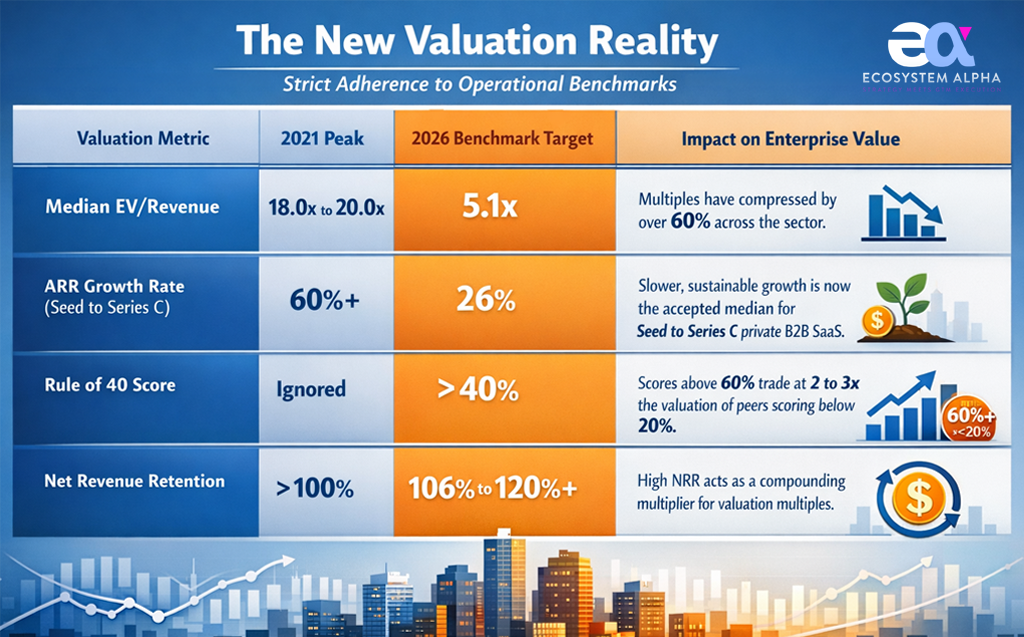
The new valuation reality demands strict adherence to specific operational benchmarks.
| Valuation Metric | 2021 Peak | 2026 Benchmark Target | Impact on Enterprise Value |
| Median EV/Revenue | 18.0x to 20.0x | 5.1x | Multiples have compressed by over 60% across the sector. |
| ARR Growth Rate (Seed to Series C) | 60%+ | 26% | Slower, sustainable growth is now the accepted median for Seed to Series C private B2B SaaS. |
| Rule of 40 Score | Ignored | >40% | Scores above 60% trade at 2 to 3x the valuation of peers scoring below 20%. |
| Net Revenue Retention | >100% | 106% to 120%+ | High NRR acts as a compounding multiplier for valuation multiples. |
The AI Threat and the Death of the Seat
This forecasting crisis is currently colliding with a structural shift in how software is consumed. For two decades, SaaS revenue predictability relied on seat based pricing. As an enterprise grew, its human headcount grew, and its software licenses grew synchronously.
Artificial intelligence is aggressively dismantling this equation. AI agents do not require a user interface, nor do they occupy a traditional software seat. When a single autonomous AI agent can seamlessly execute the daily workload of five human operators, the enterprise customer suddenly no longer requires five expensive software licenses.
This creates a cost structure inversion. Customers will proactively downgrade their seat counts in favor of untethered AI labor. If your pipeline forecast relies on historical human seat expansion, your future revenue projections are dangerously obsolete.
The Strategic Pivot: Ecosystem Led Growth
You cannot fix a broken outbound engine simply by making more cold calls. You cannot mask growth deficiencies forever by aggressively raising prices on your remaining, captive customers. The definitive, mathematically sound solution is Ecosystem Led Growth (ELG).
ELG is a go to market strategy that treats your network of integration partners and digital agencies as your most scalable channel for growth. Modern B2B buyers are skeptical and utterly overwhelmed by automated outbound noise. They rely on peer recommendations and the technologies already firmly entrenched within their stack.
By utilizing modern account mapping platforms, your RevOps and partnerships teams can securely cross reference CRM data to identify lucrative, overlapping accounts. Instead of relying on a low probability cold email, your sales team requests a highly contextual, warm introduction from a trusted partner.
This fundamentally repairs the broken pipeline. It substitutes easily manipulated, subjective rep data with high probability, partner validated buyer intent. The empirical data supporting this shift is profound.
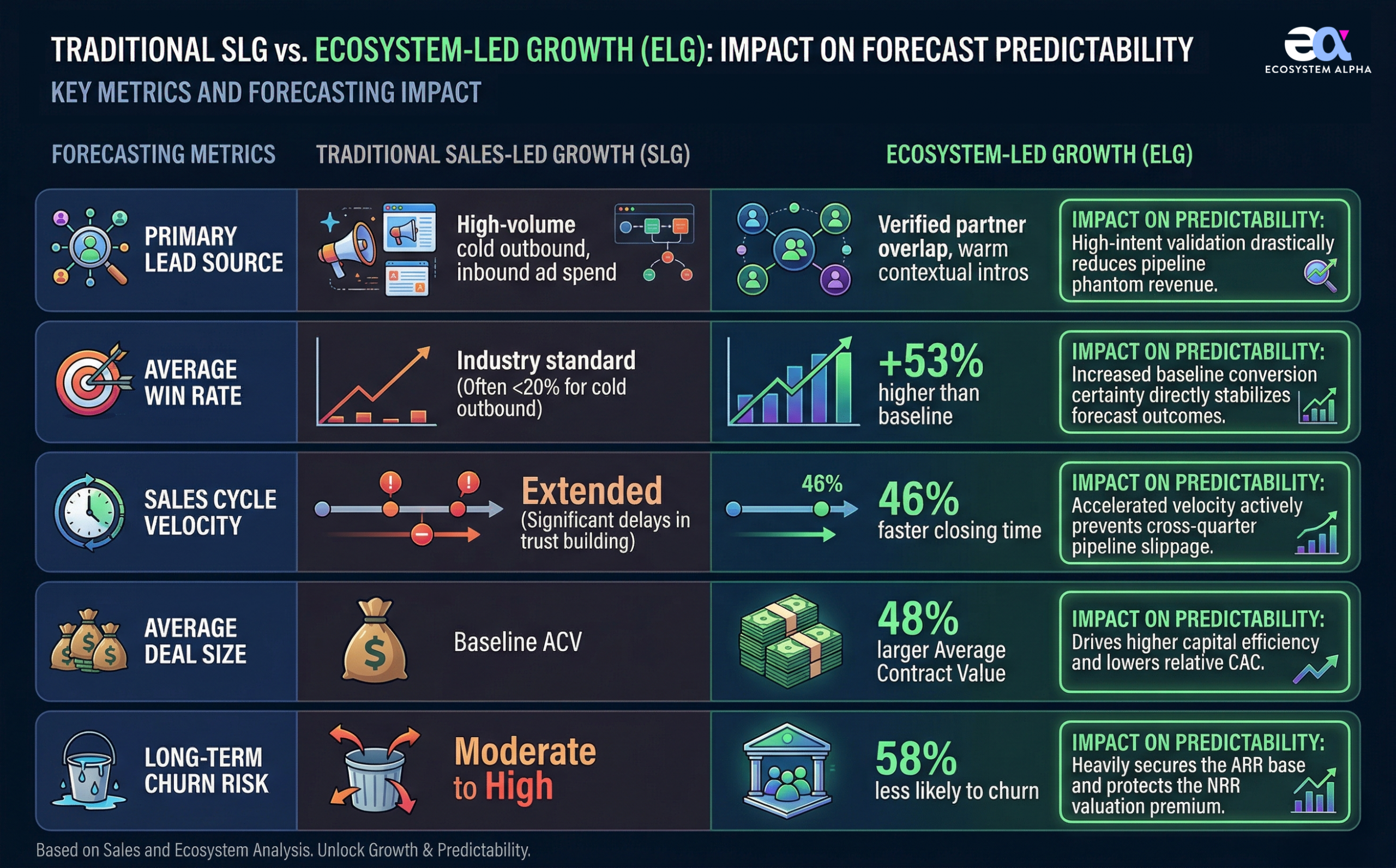
| Go To Market Metric | Traditional Sales Led Growth | Ecosystem Led Growth | The Strategic Advantage |
| Win Rate | Baseline industry standard | +53% | Partner validated leads are 53% more likely to close. |
| Sales Velocity | Prolonged by trust deficits | 46% Faster | Deals close 46% faster when leveraging ELG playbooks. |
| Average Contract Value | Baseline ACV | +48% | ELG deals possess a 48% larger Average Contract Value. |
| Customer Retention | Moderate to high churn risk | 58% Better | ELG sourced customers are 58% less likely to churn. |
The Salesforce Reality Check: Growth Through Price Increases
Consider the recent case of Salesforce. The company reported 8.7% total ARR growth for 2025. However, the bottom line tells a different story. Financial analysis reveals that aggressive price increases accounted for 6.3 percentage points of that growth. This means actual new sales volume and organic expansion contributed a mere 2.4% to their growth. When nearly three-quarters of forward growth relies purely on extracting more money from existing customers rather than winning new business, the growth narrative becomes fundamentally fragile.
Restoring Integrity: Strategies for Accurate Guidance and Forecasting
To effectively survive and rebuild trust in a market that brutally and swiftly punishes guidance misses, SaaS revenue leaders must fundamentally restructure their entire organizational approach to pipeline management and forecasting. The ultimate solution is not the aggressive application of more sophisticated, opaque predictive algorithms to dirty data, but rather the rigorous, uncompromising implementation of structural governance over the raw data inputs.
Avoiding disastrously wrong guidance requires a philosophical shift: treating the sales pipeline as a highly audited financial ledger rather than a casual repository of sales representative sentiment. Organizations must implement a forensic, systemic approach to pipeline management:
| Strategic Imperative | The Problem | The Structural Solution |
| Stage Definition Integrity | Stages rely on subjective, manual rep input. | Enforce automated CRM validation rules requiring verifiable digital evidence. |
| Close Date Accountability | Reps use rolling hope dates without justification. | Tie every close date to a verified, scheduled future event. |
| Real-Time Data Capture | Manual entry causes a roughly 30% annual CRM data decay rate. | Deploy automated platforms to ingest email and meeting sentiment directly. |
| Dynamic Forecasting | Static, seat-based ARR models are disrupted by AI agents. | Use cohort-based models tracking actual product telemetry and consumption. |
| Ecosystem-Led Growth | Cold outbound faces severe diminishing returns and buyer skepticism. | Shift from isolated direct sales to leveraging trusted partner networks. |
Ecosystem-Led Growth (ELG) as the Ultimate Strategic Solution
The definitive, mathematically proven solution to generating a highly predictable, aggressively converting revenue pipeline in this new paradigm is the widespread adoption of Ecosystem-Led Growth (ELG).
ELG is a highly collaborative go-to-market strategy that treats a company’s broader network of complementary technology partners, systems integrators, and digital agencies as its primary, most scalable channel for sustained growth. Instead of relying on expensive, low-yield direct marketing and cold calls, ELG actively generates pipeline by leveraging the existing, highly trusted relationships firmly established within a partner ecosystem. The foundational thesis of ELG is highly logical: a company’s absolute best next customer is likely already an active, deeply satisfied customer of one of its strategic ecosystem partners.
The mechanics of ELG rely heavily on “Ecosystem Intelligence,” a data layer powered by modern account mapping platforms such as Crossbeam. These Partner Ecosystem Platforms (PEPs) act as secure, highly governed data escrows. They allow two distinct, non-competing software vendors to securely cross-reference their respective CRM data to identify lucrative, overlapping accounts without exposing sensitive raw data. When an exact overlap is digitally identified—for instance, an enterprise prospect heavily targeted by Vendor A is already a highly engaged, high-spending customer of Vendor B—Vendor A’s sales team no longer relies on a cold email. Instead, they leverage the platform to request a highly contextual, warm introduction directly from their counterpart at Vendor B.
By fundamentally shifting the go-to-market engine toward ELG, revenue operations teams can construct vastly superior, highly resilient forecast models. ELG fundamentally changes the raw mathematics of the sales pipeline, entirely substituting low-probability, easily manipulated cold outreach with high-probability, partner-validated buyer intent. The empirical data supporting ELG’s dramatic impact on pipeline predictability and overall sales efficiency is profound:
Dramatically Higher Win Rates: Ecosystem-Qualified Leads (EQLs) sourced directly through active partner networks are empirically 53% more likely to close than traditional, cold outbound leads. The active presence of a trusted technology partner acting as an intermediary instantly bypasses the massive initial friction of establishing vendor credibility, ensuring that deals entering the forecast have a mathematically higher baseline probability of success.
Accelerated Deal Velocity: Deals heavily influenced by partner ecosystems and joint go-to-market motions close 46% faster. Presenting a joint solution with pre-built, seamless integrations significantly reduces the customer’s technical evaluation time, mitigates deployment risk, and rapidly accelerates the procurement cycle, actively preventing the pipeline slippage that routinely destroys quarterly forecasts.
Increased Contract Value and Massive Retention: Partner-influenced deals consistently yield a 48% larger Average Contract Value (ACV) and ultimately result in customers who are an incredible 58% less likely to churn. Enterprise customers utilizing deeply integrated, multi-vendor solutions inherently experience significantly higher switching costs, dramatically improving the software’s operational stickiness and heavily securing long-term Net Revenue Retention, thereby protecting the company’s valuation multiple.
To effectively and accurately forecast an ELG-driven pipeline, companies must track highly specific partnership attribution metrics within their CRM. This requires maintaining strict, audited CRM definitions differentiating deals a partner actively originated (partner-sourced) versus deals where a partner assisted in accelerating an existing opportunity (partner-influenced). Furthermore, organizations can utilize AI to score pipeline health based directly on ecosystem signal strength; an active deal in the pipeline that utilizes three interconnected, verified ecosystem integrations possesses a mathematically and empirically higher likelihood of closing than a highly isolated, standalone point-solution deal.
Ultimately, embracing Ecosystem-Led Growth completely insulates SaaS companies from the inevitable collapse of traditional, direct-sales pipeline mechanics. In a rapidly evolving market where autonomous AI agents are actively diluting the inherent value of the individual software “seat,” the deep interconnectedness of the ecosystem becomes the ultimate, unassailable defensive moat. Modern enterprise buyers are increasingly purchasing highly integrated, automated workflows rather than isolated, standalone applications. By strategically positioning a product as a highly trusted, critical node within a much broader, interconnected ecosystem, software companies protect their pricing power, ensure their pipeline is filled with highly qualified, predictable demand, and mathematically guarantee the accuracy of their financial guidance.
The Imperative for the C Suite
For executives leading MarTech, SalesTech, and Data platforms, the mandate is clear. No software functions as an island anymore. Modern buyers demand composable, interconnected tech stacks.
To survive the ongoing valuation correction and the AI driven collapse of seat based pricing, your product must become a highly trusted, deeply integrated node within a broader technological ecosystem. Embracing ELG provides the high quality, verifiable pipeline signals necessary for accurate revenue forecasting. It secures your Net Revenue Retention. Ultimately, it defends your valuation multiple.
The era of isolated, brute force software sales is over. The ecosystem era has arrived. It is time to build accordingly.
Conclusion
The SaaS landscape has permanently changed. The days of hyper-growth fueled by cheap capital, easily manipulated pipeline metrics, and brute-force outbound sales are gone. Today, the market strictly rewards efficiency, profitability, and absolute predictability. As AI agents rapidly dismantle the traditional seat-based pricing model, reliance on outdated forecasting methods guarantees catastrophic valuation corrections. The path forward is clear: revenue leaders must implement rigorous data governance and transition fully to Ecosystem-Led Growth. By leveraging trusted partner networks, companies can bypass market noise, accelerate deal velocity, and build a highly resilient, predictable revenue engine.
How EcosystemAlpha Can Help Your Company
Navigating this transition requires specialized expertise, and that is exactly where EcosystemAlpha steps in. We help B2B SaaS companies architect, implement, and scale high-performing Ecosystem-Led Growth strategies. From mapping your ideal partner landscape and operationalizing secure account data sharing, to training your revenue teams on partner-influenced sales motions, EcosystemAlpha provides the strategic blueprint and hands-on guidance necessary to transform your partner network into your most reliable, predictable, and cost-effective channel for sustained revenue growth.