David vs. Goliath: Why Smaller Partnerships Often Deliver Bigger Results

Despite the appeal of massive “Goliath” partners, smaller organizations frequently deliver better results through faster execution, deeper collaboration, and a focus on true value rather than vanity metrics.
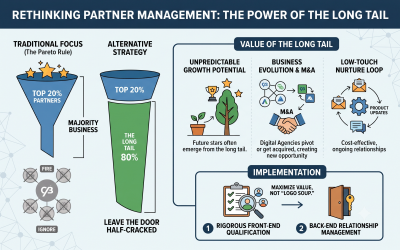
There is often a strong desire in business to seek out massive, large-scale partners. Organizations naturally gravitate toward these “Goliath” partners because of their immense reach, broad client coverage, and the sheer numerical size of their distribution opportunities. However, in the pursuit of scale, companies often overlook a crucial reality: smaller, nimble organizations can frequently move the needle much faster and make significantly better partners.
The Product Perspective: Engagement Over Optics
When building integrated software ecosystems, the true value of a partnership relies heavily on cross-company product collaboration. According to Agata Bugaj, Chief Product Officer at Butterfly MX and recent guest on our podcast, successful integrations must solve real workflow friction for the end user rather than merely serving as a PR announcement or a vanity partnership . Achieving this requires deep, active engagement from both technical teams and a direct connection between product groups—something that is often harder to establish in large organizations.
When evaluating potential partners, prioritizing alignment over raw market share is crucial:
- Internal Relationships: A partner’s willingness to prioritize an integration matters just as much as market breadth.
- Ease of Collaboration: A smaller partner that is easy to work with can actually be more valuable than a larger partner that is difficult to coordinate with .
- Evaluating True Value: Company 1 might theoretically offer more value because 40% of your customers use them, compared to Company 2 at 30%.
- The Cost of Friction: However, if Company 1’s team is hard to reach, lacks organization, or doesn’t view you as a priority, the integration will take much longer and cause more frustration.
- Speed to Market: In contrast, Company 2 can help you get to market faster and deliver more actual value, despite the slightly smaller initial customer overlap.
Bugaj also champions the principle that “clarity is kindness” in partnerships. If a large partner is non-committal, hard to get on the phone, or creates friction, it is better to realize they might just not be that into you and move on, rather than trying to push a boulder up a hill .
Agility in Go-To-Market Motions
Beyond product development, smaller partners offer distinct, high-impact advantages in your overall go-to-market (GTM) strategies. In the fast-paced SaaS business world, being nimble is often more important than sheer size. By partnering with smaller organizations, you gain critical agility across both marketing and sales. Instead of waiting months or quarters to execute massive, slow-moving campaigns or fighting for the attention of a distracted enterprise sales rep, you can launch “just-in-time” marketing activities and build deeply engaged co-selling motions.
The Marketing Advantage: “Pop-Up” Precision and Speed
When executing marketing initiatives with massive organizations, the planning cycle can stretch out for months or even quarters just to coordinate big things. Smaller partners circumvent this bureaucratic drag, offering a massive advantage in speed and responsiveness to the marketplace.
- Just-in-Time Execution: A nimble partner can rapidly spin up targeted marketing activities.
- Rapid Turnaround: If an opportunity arises in the market, a smaller partner might be willing and able to collaborate on an executive dinner with just a two-week turnaround.
- “Pop-Up” Marketing: Think of this approach like a pop-up restaurant; it is highly reactive, highly targeted, and can turn around very quickly to capture immediate market interest.
- Moving the Needle Faster: Because these joint marketing efforts can go live so quickly, they often move the needle much faster than waiting for a large partner’s rigid quarterly marketing plan to align with yours.
The Sales Advantage: Mindshare and Meaningful Pipeline
When companies partner with massive organizations—such as major hyperscalers or large enterprise sales forces—they often expect an immediate flood of new business. However, the reality of working with Goliath is that your product is usually just one of countless solutions competing for a sales rep’s attention.
- Securing Mindshare: Because large partners juggle so many competing priorities, getting their sales teams to actively focus on and pitch your product can be a difficult challenge. Smaller partners, by contrast, have less pull in other areas of their work and are able to work much more closely with your team.
- Deep Mental Engagement: A nimble partner will take the time to mentally engage with your solution and get to know your team on a personal level. This dedicated focus is what truly jumpstarts solid co-sell motions and proves how the joint solution works.
- Quality Over Quantity: A small partner might not bring as many sheer numbers to the table as a large partner, but the opportunities they do bring are inherently deeper and present a much stronger opportunity to close good deals.
- Aligning Value and Distribution: Tracking raw customer volume is frequently an overrated metric . While go-to-market teams often view customer count as the ultimate goal, it merely measures the quality of distribution, not whether the product is actually effective or valuable for the user . Smaller sales partners focus on matching the right customers to your solution, ensuring that closed deals result in actual value rather than just vanity metrics.
The Delivery Advantage: Value Realization and Unshakable Trust
A closed deal is only the beginning; the delivery phase is where product promises must translate into actual value realization for the client. Managing the entire lifecycle—from onboarding through ongoing service—jointly with a third party is notoriously difficult.
- The Pitfall of Diluted Expertise: A common frustration with large implementation partners is that you can spend vast resources training hundreds of their consultants, only to find that they possess just surface-level knowledge of your software. Furthermore, these massive firms frequently reassign their personnel, meaning the people you trained yesterday might be moved to a completely different project today.
- Process Adaptability: Smaller delivery partners are inherently nimble and are much more willing to adjust their internal processes to seamlessly integrate with yours, allowing you to mutually adapt and provide a unified front to the end customer.
- Building Internal Trust: When a smaller partner dedicates even a handful of highly trained individuals—or a single expert—to your product, it drastically alters the dynamic. It proves to your internal services organization that outsourced partners can handle your clients with the same, or even greater, care than your own internal team.
- Shared Visibility: Smaller partnerships allow for transparent, shared visibility into each organization’s long-term actions and overarching goals, resulting in far better strategic alignment.
Measurement and Governance: Clear Metrics and Executive Alignment
When managing a partnership, the structural dynamics—how you measure success, how you govern the relationship, and who is steering the ship—can make or break the alliance.
- Executive Access and Alignment: One of the most significant advantages of smaller partnerships is the ability to align your executive teams much more easily. In these relationships, you can get direct access to more senior leadership and quickly align on an objective.
- Strategic Governance: This close-knit leadership dynamic fosters shared visibility into what the partner organization is planning for the longer term. This mutual transparency ensures that both sides have shared goals in alignment.
- Meaningful Metrics Over Vanity Numbers: Smaller partners are generally more willing to evaluate the relationship based on metrics that prove true value realization. Tracking the raw number of customers is frequently overemphasized; while customer volume indicates the quality of distribution, it fails to measure whether the product is effective or provides actual value to the user .
- Tracking Defensibility: Smaller partners are nimble enough to align their measurement to track complex indicators of user adoption. For example, Butterfly MX identifies their single data point to prove product defensibility as the share of buildings where their system syncs live with a property management system, offering a clearer picture of value than raw customer counts.
The Bottom Line
Big partners might look impressive, but smaller, agile teams often make better partners who can move the needle much faster. Ultimately, successfully delivering revenue and business outcomes with a handful of small, deeply committed partners generates a powerful flywheel of trust. Many successful SaaS businesses have started exactly this way, relying on meaningful, lasting relationships with small partners to drive an incredibly meaningful impact on their business before expanding to work with large organizations.