The Gamechanger Playbook: Engineering Partnership Big Bets and the Rules of Growth
By Sebastian Hoelzl,
Most B2B SaaS companies treat strategic partnerships as a volume game. Gautham Pandiyan, Global Head of Partnerships at Pendo, explains why the ones that actually move the needle require a completely different playbook.

There is a version of partnership strategy that produces logos on a website and another that produces nine-figure revenue lines. The gap between the two is not effort or ambition. It is the decision-making framework used to select, resource, and evaluate the bets that matter most. Gautham Pandiyan, Global Head of Cloud, SI & Affiliate Partnerships at Pendo, has sat in both worlds. In this conversation, he breaks down how senior GTM leaders can identify which partnerships are worth transformational investment, how to know when to stop, and how to build the internal narrative that keeps a strategic bet alive long enough to pay off.
The case for picking fewer bets and picking them better
The instinct in most partnership functions is to accumulate. More logos, more signed agreements, more activity tracked in a CRM. Pandiyancalls this the “moth going after the flame” problem. The large marquee names attract attention, absorb resources, and often produce nothing at the pace the business needs.
His alternative starts with a single question: where has your business already found product-market fit? Partners amplify that signal. They do not find it for you. The companies that try to use a strategic partnership to discover their own market fit are starting a long and expensive science project with someone else’s sales organisation. The ones that win have enough direct revenue, enough customer proof points, and enough pattern recognition in their own sales cycles to know exactly where a partner can accelerate what is already moving.
From there, Pandiyan looks for natural pull: signals from customers, from win-loss data, from sales teams asking for a specific partner by name. When that pull exists, resourcing a strategic bet becomes a faster, more defensible conversation. When it does not exist, the risk of pushing a very large rock up a very steep hill is significant.
The fail-fast framework
One of the most commercially costly beliefs in partnership strategy is that a big bet requires a long incubation window. Pandiyan challenges this directly. At Pendo, his team co-created a joint venture pod with an SI partner to accelerate an AI product to market. The pod was co-funded, co-staffed, and designed to operate with startup speed inside the parent company. Within five months, the team was evaluating signals on a weekly and bi-weekly basis, making role changes, and ultimately transitioning one element of the initiative that was not performing as intended.
The key mechanism here is what Pandiyan calls pre-mortems: structured forward-looking reviews that ask where a partnership is heading off track before it gets there, rather than waiting for a quarterly post-mortem to confirm what everyone already suspected. Combined with clearly defined milestones at regular intervals, this approach lets a leadership team make a genuine go or no-go call based on real data, rather than sunk cost and internal momentum.
The discipline applies with even more force to large GSIs and hyperscalers, where the risk of spending significant time and resource with nothing to show for it is highest. Having a named champion on the partner side, a clearly stated value exchange, and explicit agreement on where a partner fits in the customer lifecycle (demand generation, deal acceleration, or post-sale value) are the conditions that make early failure signals readable and actionable.
What the Qualtrics and AWS story actually teaches
Pandiyan’s most cited proof point is the AWS partnership he built at Qualtrics, which reached $150 million of revenue through the AWS Marketplace over four years. He is deliberate about how he tells that story, because the lesson is not simply that hyperscalers drive revenue. It is that the outcome required years of cross-functional work, internal advocacy, and a specific unlock that most teams overlook.
That unlock is native consumption. The question is not whether your product can list on a marketplace or participate in co-sell. It is whether your product drives consumption of the hyperscaler’s own services. When that connection is clear and provable, the hyperscaler’s field sales teams have a commercial reason to bring your product into deals. Without it, you are competing for attention in an ecosystem with thousands of partners and no natural reason for anyone to elevate you above the noise.
The implication for any SaaS business evaluating a hyperscaler bet is practical. Prove out the consumption connection in a narrow segment before asking for broad co-sell support. Track your own pipeline contribution before expecting the hyperscaler to contribute theirs. Build the cross-functional team, because the partnerships leader alone cannot move a bet of this size.
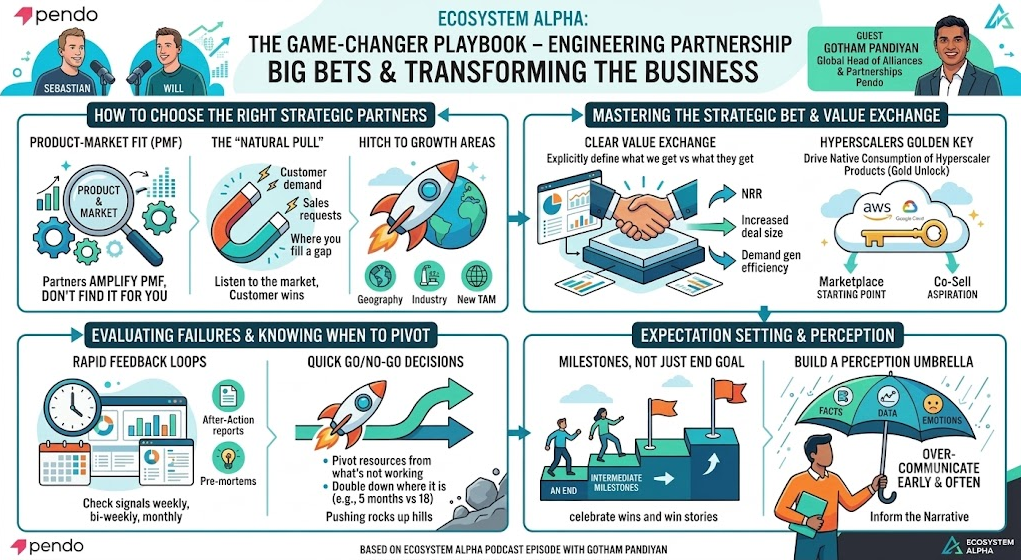
The infographic summarises the four core frameworks from this conversation: how to choose the right strategic partner, how to master the value exchange and identify the hyperscaler unlock, how to run rapid feedback loops and make go or no-go decisions, and how to set expectations and build the internal perception umbrella that keeps executive support in place.
This visual maps the Game-Changer Playbook from Gotham Pandiyan’s conversation with Ecosystem Alpha, covering partner selection, value exchange, failure signals, and expectation setting.
The difference between a partnership that transforms a business and one that consumes its resources without return comes down to three things: whether the underlying product-market fit is real before the partner enters the picture, whether the value exchange is explicitly defined from the start, and whether the team has the discipline to read failure signals early and act on them. Listen to the full conversation with Gautham Pandiyan on the Ecosystem Alpha podcast at ecosystemalpha.com.
About Gautham Pandiyan
Gautham Pandiyan is Global Head of Cloud, SI & Affiliate Partnerships at Pendo, where he leads the company’s hyperscaler, GSI, and consulting partner motions. Before Pendo, he spent four years at Qualtrics building the AWS partnership from a small internal pilot to a $150 million Marketplace revenue line, earning Partner of the Year recognition in key industry segments along the way. He has held senior alliance and partnership roles across multiple high-growth SaaS businesses, giving him a perspective on ecosystem strategy that spans early-stage partner motion building all the way through nine-figure channel scale. He speaks regularly on how partnership leaders can earn and maintain a seat at the commercial leadership table.
Chapters
- Introduction and guest background
- How to choose the right strategic partners: product-market fit and natural pull
- The difference between push and pull in channel-first versus overlay models
- Evaluating failures and knowing when to pivot
- Hyperscalers in practice: the Qualtrics and AWS story
- Expectation setting, the perception umbrella, and managing internal stakeholders
- Rapid-fire round and recommended voices
⭐️ Leave a Review: If you enjoyed this episode, please follow Ecosystem Alpha on Spotify and leave us a 5-star review! It helps us bring more incredible guests onto the show.