The E-commerce Ecosystem: Scaling International GTM via the Partner Network
By Sebastian Hoelzl,
JD Klausner, SVP Partnerships at Commerce, has spent a decade building partner ecosystems at fast-scaling e-commerce companies. His verdict: the most capital-efficient path to a new market runs through partners, not the payroll.

Most B2B SaaS companies treat international expansion as a headcount problem. Hire SDRs in the target market. Localise the website. Pump budget into regional ads. Then wait twelve months to find out whether the bet paid off. JD Klausner has spent a decade building partner ecosystems at fast-scaling e-commerce companies, and he has a different view: the most capital-efficient path to a new market runs through the partner network, not the payroll.
E-commerce as the proving ground for ecosystem-led growth
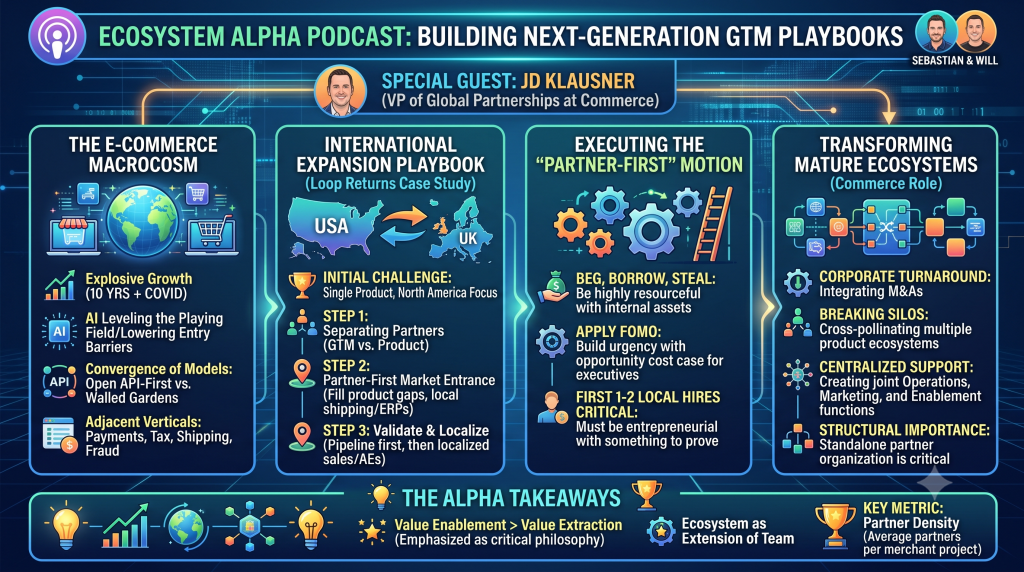
The e-commerce vertical has been forcing the evolution of partner-led go-to-market faster than any other segment of B2B SaaS. Three dynamics have compressed the timeline.
First, explosive growth over the past decad, accelerated sharply by Covid, has created an ecosystem of hundreds of adjacent vendors across payments, tax, shipping, fraud, and returns. No platform can own all of it. The partner ecosystem is not a channel add-on; it is the product architecture.
Second, AI is lowering entry barriers and levelling the competitive playing field. New merchants can now launch, integrate, and operate at a fraction of the cost they could three years ago. That compression makes the quality of the surrounding partner ecosystem, the agencies, the SIs, the tech integrations, the primary differentiator.
Third, the market is bifurcating between open API-first platforms and walled gardens. The winners in this bifurcation will be the platforms whose ecosystems generate the most merchant value. That is an ecosystem density game, not a feature game.
In this context, Klausner argues that the old international playbook, dump capital into local headcount and demand generation, is not just expensive. It is structurally obsolete.
The three-step partner-first entry sequence
Klausner’s practical framework for entering a new international market starts with a foundational distinction: GTM partners and product partners are not the same thing, and conflating them is the most common execution failure.
GTM partners, digital agencies, system integrators, regional resellers, are how you generate pipeline before you have local credibility. Product partners, ERPs, local payment rails, regional shipping providers, are how you fill the capability gaps that make your core platform viable in that market. Step one is to map both, separately, before anyone in the new market signs an employment contract.
Step two is partner-first market entrance. Enter through the local agencies and SIs. They bring the trust relationship with the merchant, the knowledge of local compliance requirements, and the referral pipeline you would otherwise spend eighteen months and significant CAC building cold. Klausner describes the first hires in a new market as needing to be highly entrepreneurial, commercially wired, and hungry to prove themselves, because they are operating in a largely unstructured environment where the ability to “beg, borrow, and steal” internal resources determines whether the market opens or stalls.
Step three is validation before scale. Run pipeline first. Only once partner-attached deals are closing, and closing at a healthy rate, do you localise further: hire field AEs, invest in regional marketing, and build out the local support infrastructure. This sequence inverts the traditional model. It reduces the capital at risk in the early stages and produces real revenue signal before you commit to the full operating cost of a local go-to-market machine.
Executing the partner motion: from theory to sales floor behaviour
The most technically sound partner strategy in the world fails if the internal sales team does not use it. Klausner is direct on this point: “commission breath”, the instinct of AEs to guard their pipeline from partners they see as margin threats, is the primary execution failure in partner-first models. Solving it is an operating model problem, not a training problem.
Three levers move the needle. The first is applying FOMO: building the opportunity cost case for executives by showing what closed-lost analysis looks like in markets where the partner motion was not activated. The second is the operating model: designing compensation and co-selling rules so that attaching a partner to a deal is always in the AE’s interest, never a penalty. The third is the quality of the first local hire. The person who opens a new market sets the internal narrative about whether partners are assets or obstacles. Getting this wrong creates a cultural problem that takes years to undo.
For mature ecosystems, particularly those navigating M&A integrations or multi-product expansion, the structural answer is a standalone partner organisation with its own operations, marketing, and enablement functions. Cross-pollinating multiple product ecosystems requires a dedicated centre of gravity. Without it, the partner function gets subsumed by direct sales priorities and degrades into a reactive support function.
The operating model underneath the strategy
The central argument of this episode is that a partner programme does not fail because the partners are wrong. It fails because the operating model underneath it was never designed to succeed. Klausner’s body of work at Yotpo, Loop Returns, and now Commerce is a live case study in building that operating model from first principles, in three different company contexts, across multiple geographies.
Chapters
- 13:00 – The Loop Returns UK case study: separating GTM from product partners
- 21:00 – Executing the partner-first motion: beg, borrow, steal and applying FOMO to executive buy-in
- 31:00 – Curing commission breath: getting AEs to co-sell through the ecosystem
- 39:00 – Transforming mature ecosystems: M&A integration, breaking silos, and the standalone partner org
- 46:00 – Rapid fire: the most overrated metric, partner density, and what to read next
- 50:00 – The revenue receipt and closing alpha takeaway
⭐️ Leave a Review: If you enjoyed this episode, please follow Ecosystem Alpha on Spotify and leave us a 5-star review! It helps us bring more incredible guests onto the show.