Behavioral Marketing to Agentic Orchestration: Architecting AI & Ecosystem Automation

By Sebastian Hoelzl,
Most AI projects start with a tool and end with a modest saving. Riaz Kanani starts somewhere else entirely, and the numbers end up looking completely different. Here is what agentic orchestration really looks like once a revenue team builds it in the right order.

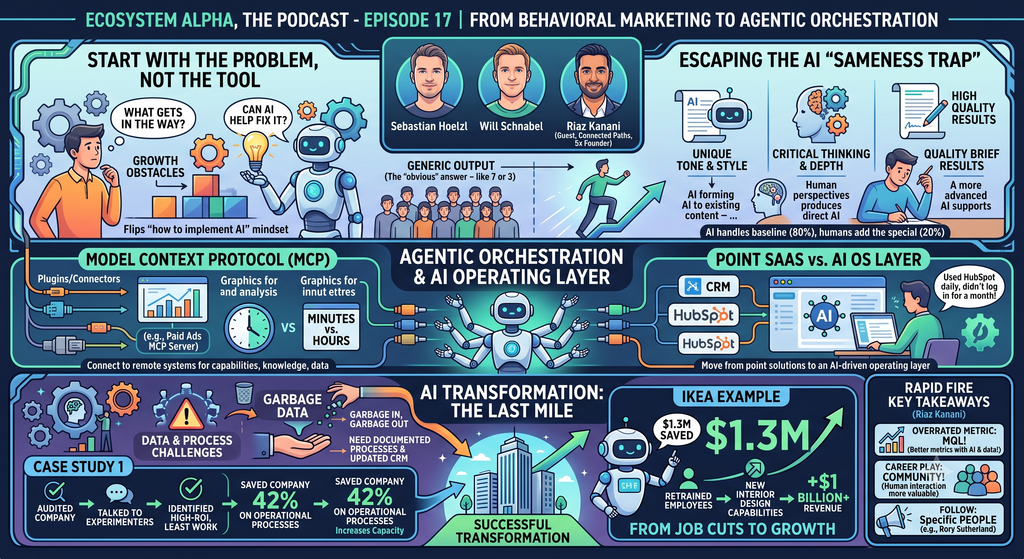
Every revenue leader now has an AI budget. Far fewer can truly quantify the impact. The gap does not come from the models, because the models are more than good enough. It comes from the question teams ask first. Most start with the tool, then hunt for somewhere to use it. Riaz Kanani, a 5x founder and technology strategist, starts with the thing blocking growth, and only then asks whether AI can help. On this insightful podcast episode, he showed what that reframe is worth. One audit found a 42 percent saving on a single operational process, and it also freed capacity the sales team could use elsewhere.
Start with the blocker, not the tool
Kanani puts the reframe in one line. The right question is not how we implement AI. Instead, it is what gets in the way of growth, and whether AI can fix it. That sounds obvious, however most companies do the opposite. They hand the work to whoever is keenest on AI, so that person automates their own tasks. As a result the needle barely moves.
His team runs the reverse order. First they audit the business. Then they talk to leadership, and they also talk to the people already experimenting. Only then do they rank the options by return against effort. Because the ranking comes last, the first project is usually the one with the biggest payback and the least work.
Two things get in the way, and both are unglamorous. Most companies have never documented their processes, or the documents are out of date. Their CRM data has gone stale as well, so the model reasons from gaps it never mentions. Garbage in, garbage out still holds. However AI now says the garbage back to you with total confidence.
The sameness trap and the frameworks that break it
Every marketing team now runs the same base models, so the output converges. Kanani calls this the sameness trap. He gets out of it in two moves.
First, he feeds the model his own published writing. The tone then starts from him rather than from the average of the internet. That handles style, but judgment is the harder half. Because AI is built to give the most likely answer, it drifts to the obvious. Ask it for a number between one and ten and it will usually say seven.
Second, he insists on a point of view before the model writes anything. The moment you supply your angle, the output leaves the generic path. He also warns that models flatter weak ideas, so you have to challenge the answer and ask it to verify its own facts.
Kanani pointed to research from Anthropic on how models hold related concepts together while they answer. When a model skips that step, it jumps straight to a confident reply. That is where most bad output comes from, and it is also where a human should step in.
What it looks like in practice
Kanani built an MCP server for paid advertising. It reads his live campaigns, then reports what is working and what has gone stale. Work that used to take an hour of exporting and reformatting now takes minutes. He uses connectors like this 80 to 100 times a day.
The second order effect matters more than the time saved. He is a HubSpot customer who has not logged into HubSpot for about a month, yet he uses it every day through his assistant. Point tools do not disappear. However the interface moves up a layer, which is what people mean by an AI operating layer.
His favourite proof point is IKEA. A chatbot saved the company 1.3 million on the bottom line, and it could have justified 6,500 job cuts. Instead the company retrained those people into interior design roles, which added a revenue line worth more than a billion dollars. That is the gap between an efficiency story and a growth story, and revenue leaders should hold out for the second one.
What the infographic shows
The infographic below maps the whole conversation onto one page. It follows the argument from the opening reframe through the sameness trap, then into MCP connectors and the move from point software to an AI operating layer. The bottom band carries the numbers, including the 42 percent saving and the IKEA turnaround. Use it as a one page briefing for your leadership team.
The bottom line
Treat AI as a transformation project rather than a tool rollout, because process, data and people still decide the outcome. Kanani has the receipts on both sides of that line. Notice that every win started with an audit and finished with a tool, never the other way round. Listen to the full conversation on the podcast page, then pick the one blocker in your own funnel that could be worth 42 percent.
About the guest
Riaz Kanani is Founder and CEO at Connected Paths, an AI implementation consultancy based in London. Before that he spent nearly nine years as CEO of Radiate B2B, the intent data and advertising platform for B2B teams. Earlier in his career he built behavioural email and marketing automation inside the platforms that created the category, and he co founded the video technology business that became Digital Oxygen. Across five companies he has sat on the commercial side of every major shift in digital growth, which is why his read on AI runs to revenue rather than novelty.
⭐️ Leave a Review: If you enjoyed this episode, please follow Ecosystem Alpha on Spotify and leave us a 5-star review! It helps us bring more incredible guests onto the show.