Demystifying the Last Mile of Enterprise AI Data Adoption in B2B SaaS
By Sebastian Hoelzl,
Enterprise data warehouses move information in milliseconds, but the people who make decisions from that data are still waiting on a phone call or an email. Rishi Bhatnagar says this gap between fast data and slow decisions is quietly costing revenue leaders billions every year.

A company can spend millions on pipelines that move data from a dozen source systems into one warehouse within seconds. Then a division leader asks a simple question about cost, churn, or pipeline coverage, and the answer takes a week. Someone still has to track down the one person who knows where to look. Bhatnagar built Quaeris after watching this pattern repeat inside some of the largest companies in the world. He spent the sixteen years before that as chief executive of Syntelli Solutions. He argues that the real barrier to AI and analytics adoption is not the technology. Instead, it is the last ten inches between the data and the person who has to act on it.
Data moves fast. Decisions do not.
Bhatnagar spent years building dashboards and analytics platforms for large enterprises before he noticed a troubling pattern. His team once built detailed analytics for one of the largest logistics companies in the world. The dashboard tracked how long aircraft sat on the ground compared with how long they spent in the air. Executives praised the work when it launched. Yet when he asked how they actually used it, the answer surprised him. They told him they had never opened the dashboard. Instead, they called a colleague or sent an email whenever they needed an answer.
That gap between how fast data moves and how fast people decide is where value disappears. Warehouses and pipelines can move information as quickly as the infrastructure allows. People cannot process a dashboard, interpret it correctly, and act on it at that same speed. This gets even harder when a question feels unfamiliar or urgent. Bhatnagar calls this friction between digital data and analog people. Because of it, he says companies lose billions of dollars every day through delayed decisions, duplicated work, and missed windows. Moving data fast was never the hard part. Getting a trustworthy answer into the right hands is the hard part. Most analytics investments still fail to deliver it at the moment someone actually needs it.
Headless BI and agents that learn once
Quaeris tackles this problem with what Bhatnagar calls headless BI. Rather than asking executives to log into a dashboard, the platform lets people ask questions in plain language. They can do this through tools they already use, including Microsoft Teams and WhatsApp. Behind the scenes, the system converts the question into a database query. It retrieves the answer and returns it directly inside that conversation. As a result, people never have to open a separate application at all.
Bhatnagar also raises a cost problem that most companies have not confronted yet. Many AI agents make a fresh decision at every step of a task. Each decision consumes tokens, which is the unit that AI providers charge for. By contrast, he designs Quaeris around what he calls a zero token architecture. Here, an agent learns a path once and repeats it without deciding again at every step. It works much like a driver who stops thinking about the route after a few trips. Token consumption is revenue for the AI labs and cost for the enterprise buying the service. Because of this, Bhatnagar argues that agent design choices around efficiency will decide which deployments survive contact with a finance team. Performance in a demo is not enough.
What this means for enterprise adoption
The scale of the adoption problem is significant. Bhatnagar points to research from Cisco showing that 85 percent of companies have started some kind of AI initiative. Yet only 5 percent have fully adopted one. He attributes most of that gap to skepticism about security and governance. It is not a lack of interest in the technology. When a company moves fast on AI, security and governance are usually what gets left behind. Enterprise buyers know it.
This is also why Bhatnagar believes partnerships matter more, not less, as AI matures. A platform like Quaeris can answer a large share of an enterprise question set, but every company stores data differently. Someone still has to know which date column matters in a given system. Is it the invoice date, or the shipping date? For this reason, Bhatnagar compares Quaeris to Palantir‘s forward deployed engineer model. In that model, people who understand a client’s specific business processes sit between the product and the customer. He has built partnerships into Quaeris for the same reason. A recent example is the partnership with ClickHouse, which pairs an efficient data layer with a more intuitive way for people to consume it. This beats trying to build every layer of the stack alone.
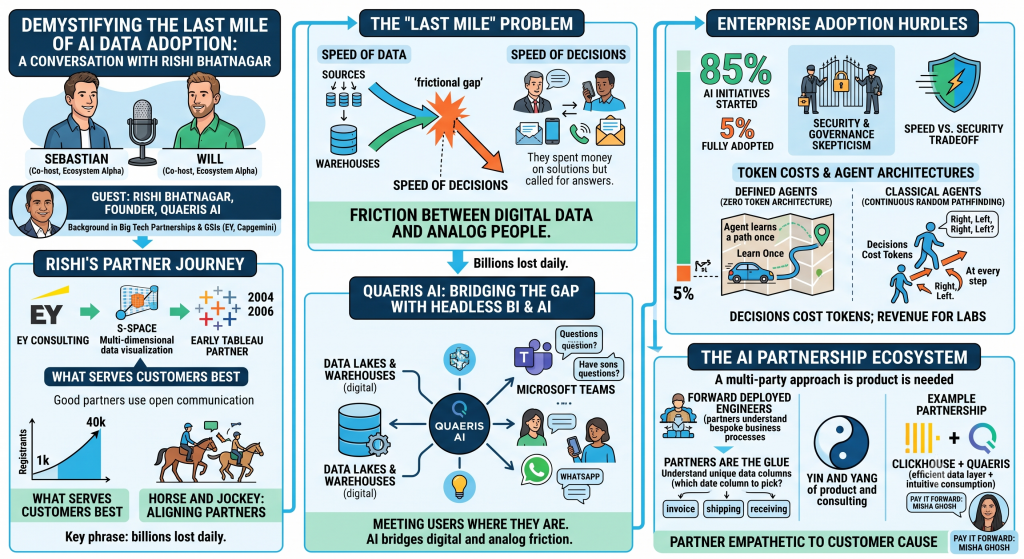
The infographic below maps the full arc of this conversation. It starts with Bhatnagar’s early partner bets, first with Tableau and then with Spotfire. From there, it moves to the last mile problem he identified at a global logistics company. Finally, it shows how Quaeris uses headless BI to close the gap between data and decisions. It also breaks down the adoption statistics and token cost dynamics shaping which AI deployments actually reach enterprise scale.
The bottom line
The lesson underneath all of this is simple. Moving data faster does not create value on its own. Value only appears when the right person gets a trustworthy answer fast enough to act on it. That is as much a problem of people, partnerships, and incentives as it is a problem of infrastructure. For that reason, listen to the full conversation with Bhatnagar on the Ecosystem Alpha podcast page. It covers partner strategy, token economics, and enterprise AI governance in full.
About the guest
Rishi Bhatnagar is the founder of Quaeris, an AI driven data search and BI platform. He built it to close the gap between enterprise data and the people who need to act on it. Before founding Quaeris in 2020, he spent sixteen years as chief executive of Syntelli Solutions. During that time, he grew the analytics consulting firm to seventy five people through early partnerships with Tableau and Spotfire. His career began in finance, and he later worked at Ernst and Young. That is where his interest in multi dimensional data visualization first took shape. This combination of enterprise consulting and product leadership shapes his view today. He brings a distinctive perspective on partnerships, cost, and governance in AI deployments.
⭐️ Leave a Review: If you enjoyed this episode, please follow Ecosystem Alpha on Spotify and leave us a 5-star review! It helps us bring more incredible guests onto the show.