The Revenue Reality: Balancing Short-Term Quotas with Long-Term Ecosystem Moats

By Sebastian Hoelzl,
Cold calling stopped providing results, so Blue Triangle tested it properly and got only one reply from thousands of attempts. Here is how a Chief Revenue Officer now architects revenue across three time horizons, and the single number he watches to see which customers are about to leave.

Most teams argue about outbound with passionate opinions. Buchholz let the numbers decide, and ran a test instead. Blue Triangle hired summer interns, put them behind automated dialing systems with a short script, and ran the motion for three months. The volume reached thousands of calls and possibly tens of thousands. One person picked up. That person said they thought it was somebody else and hung up. The test produced no sales conversations at all.
The point is not that phones are dead. The point is that buyers now filter everything they do not recognise, and every channel that once carried a cold approach carries far more noise than it used to. LinkedIn messages that got a reply ten percent of the time now get a fraction of a percent.
So the thesis Buchholz has carried through 25 years and several partner organisations holds harder than ever. The fastest route into a customer runs through somebody the customer already trusts. That is not a philosophy about partnerships. It is a statement about how much time and money a revenue team wastes trying to earn attention from a standing start, when a partner can hand it over in a single introduction.
Three horizons, one plan
Buchholz does not describe his revenue plan as a partner strategy. He describes it as three horizons that have to run at the same time. Near term revenue comes from customers who already pay. Upselling an existing account is faster than winning a new one, because the contract exists, the buying group is known, and the roadmap conversations happen every week or two anyway.
Mid term revenue comes from smaller partners and resellers. These firms sit local to a customer’s headquarters, often supporting the same accounts for decades, and a quarter of a million dollar deal is meaningful money in their commission structure. That makes them responsive.
Long term, enterprise revenue comes from the large service providers and integrators. Blue Triangle took eighteen months to put a service agreement in place with Kyndryl, one of the world’s largest provider of IT infrastructure services. That looks slow until a retail buyer says yes and then explains that an outsourcer runs the systems in question. Without the paperwork already done, that conversation adds another year.
The three horizons protect each other. The near term funds the business, the mid term feeds the pipeline, and the long term removes the blockers that would otherwise kill enterprise deals before they start.
What this changes on Monday
The practical work sits in retention, and Buchholz is direct about what puts a contract at risk. A customer who uses only the common parts of the product is exposed. A customer who has never integrated the product into their other systems is exposed, because anything that plugs in can be unplugged. A customer with no partner inside the account is the most exposed of all. Blue Triangle tracks these signals in Vitally alongside meeting history and feature use.
One story makes the case. A large retail pet business had more than 250 active users in the Blue Triangle portal and a dedicated Slack channel running between the two companies. A new executive arrived, brought a budget and a vendor they had used before, and moved the money. The people who relied on the product every day lost it. Nobody could explain the commercial cost of that switch to the new executive, because no trusted third party was in the room to do it.
That is why Buchholz sets comp plans that pay on outcomes rather than on the source of a lead. Arguments about who gets credit slow deals down and change nothing about cash collected. He would rather every seller and every partner want the same result.
The picture in one view
The infographic below maps the episode in one view. On the left sits the broken outbound motion and the noise buyers now filter out. In the centre sit the three revenue horizons, from upselling existing customers through resellers to global integrators. On the right sits the cross functional alignment that holds it together, and along the bottom sit the metrics Buchholz rejects and the one he keeps.
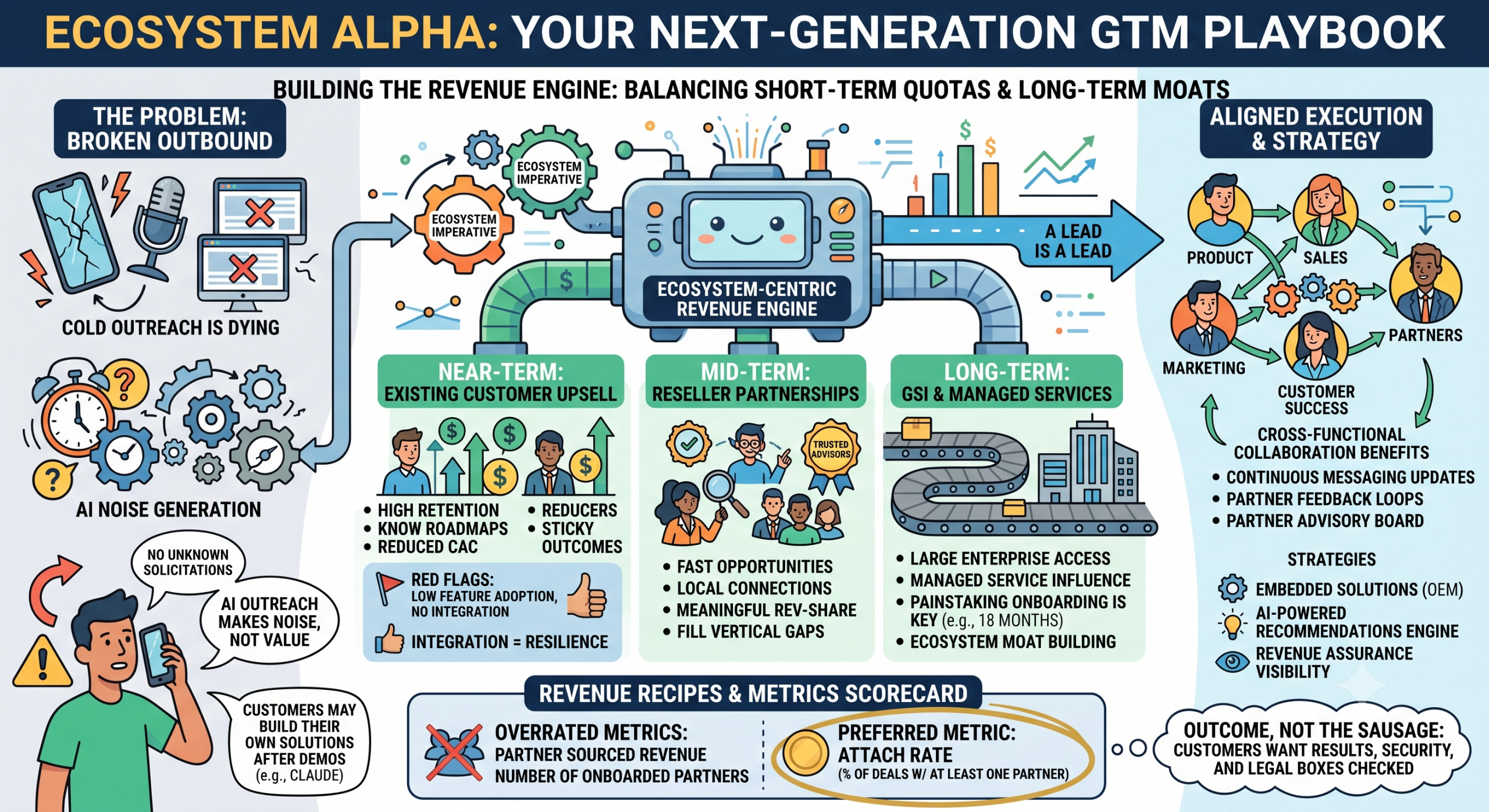
Partner attach rate is the number Buchholz would keep if he could only keep one, because a customer with a trusted partner inside the account is a customer somebody else has to fight for. Everything else in this episode follows from that. Listen to the full conversation on the Ecosystem Alpha podcast page at ecosystemalpha.com, and bring the attach rate question to your next pipeline review.
About Lance Buchholz
Lance Buchholz is Chief Revenue Officer at Blue Triangle, a digital analytics company whose customers include some of the largest names in retail, healthcare and financial services. He has spent about 25 years in partner leadership, starting with IBM WebSphere and moving through businesses of every size, including a billion dollar organisation and several companies with no partner motion in place at all. Buchholz has been part of a couple of exits on the partner side, and he joined Blue Triangle to build its partner function before taking the CRO seat. He and his wife also run Bear’s Paw, a North Carolina nonprofit that funds veterinary care for families who cannot afford it.
Chapters
- Introduction and guest background
- Bear’s Paw and the reason it exists
- The automated outbound experiment and what it returned
- Near term, mid term and long term revenue in one plan
- What AI changed about buyer conversations
- The warning signs that a customer is about to leave
- The revenue receipt: an OEM partnership that opened a new market
- Rapid fire: overrated metrics, attach rate and book picks
⭐️ Leave a Review: If you enjoyed this episode, please follow Ecosystem Alpha on Spotify and leave us a 5-star review! It helps us bring more incredible guests onto the show.