Operationalizing the ICP: Bridge Between Product Positioning & Ecosystem Velocity
By Sebastian Hoelzl,
Partner strategies stall for a reason that has very little to do with partners. When the ideal customer profile stays vague, every channel bet and every joint selling motion lands slightly off target. Here is how to find the root cause, and how to fix it before you spend another dollar.

Ask a revenue leader whether the company has an ideal customer profile and the answer is almost always yes. Ask who enforces it and the room goes quiet. That gap costs real money, because partner strategy sits downstream of it. However small the drift looks in month one, it widens fast once budget and headcount follow. So the honest question is not whether you own an ICP. It is whether the ICP actually governs where you point sales, marketing and partner effort. Newbold-Knipp has sat on both sides of that call, and she is blunt about the bill.
Why a vague ICP breaks partner strategy first
Partner strategy shows the damage earliest because it takes the longest to build. Newbold-Knipp puts it simply. When a company says it will take anyone whose money is green, that choice trickles down into every targeted play it runs. She hears the same story on repeat. A team tried a partner motion, it did not work, so the company writes partners off. However, when she unpacks the detail, the pattern is usually the same. The company doubled down on a channel that produced three early leads. Meanwhile the client base it actually wanted sat somewhere else entirely. As a result the play never had a chance, because it was never aligned to the business in the first place.
Will Schnabel frames the compounding risk in numbers a CRO recognises. Miss the customer definition by one percent at the start. By the time the motion reaches the field you are thirty percent off. Partner programs need runway, so that drift is expensive to unwind. For example, a channel built for small accounts cannot swing to enterprise buyers in a single quarter. Because of that lag, the aim has to be tighter than it feels comfortable to make it.
Two profiles, one working session
The first idea worth stealing is sequencing. Most teams define the customer profile first. Months later a different team derives the ideal partner profile from it. Schnabel argues for doing both in the same cycle instead, because the handoff is where the nuance leaks out. Newbold-Knipp agrees, and adds that in most companies nobody owns the join at all.
Her second idea is a dartboard. At the bullseye sit the accounts you build product and campaigns for. Outer rings hold opportunistic revenue you will happily take, so long as it does not distract engineering or support. Beyond those rings lies a no go zone. So the picture is about resource direction, not gatekeeping.
Her third idea speeds the whole thing up. She calls it the TAM and SAM explorer. It lets a leadership team filter live data instead of debating instinct. Set retention at ninety five percent and the profile shifts one way. Set it at ninety and it opens a different pool of near term revenue. Because the model runs in hours rather than months, strategy becomes an always on function.
What this looks like on the ground
HubSpot gives the clearest proof. Newbold-Knipp watched the company rule out solo operators as a poor fit. They simply lacked the time to run inbound marketing themselves. Those buyers needed someone to do it for them. So HubSpot referred them out, and agencies sold the software instead. That agency channel grew into roughly forty percent of company revenue over six to eight years.
A second example lands faster. Her team assumed customers wanted a mobile app. Instead she checked the technographic data and found eighty percent Salesforce penetration across the base. Advisors already lived in Salesforce all day, so an embedded experience beat a new app outright. The validation took days, not a roadmap cycle.
The attribution fight gets the same treatment. Newbold-Knipp twice asked a chief executive to hold marketing accountable for one hundred percent of pipeline rather than a slice. Both said yes, reluctantly, and both stopped hearing internal arguments about credit. Deal registration still matters, however, because some deals genuinely do not close without the partner in the room.
What the infographic shows
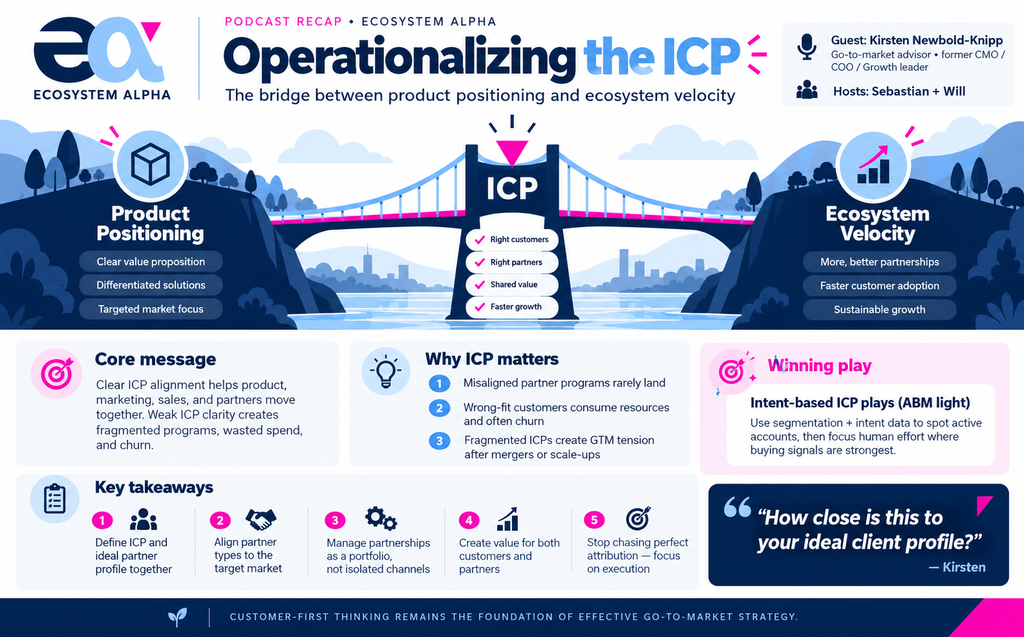
The graphic below turns the conversation into one picture. It puts product positioning on one side and ecosystem velocity on the other. Between them sits the ideal customer profile, drawn as the bridge carrying the weight. Underneath it sets out why weak ICP clarity fragments partner work. It also lists five takeaways you can test against your own operating model this quarter. Use it as a discussion prompt with your leadership team rather than a poster.
The bottom line
A sharp customer definition is the cheapest way to protect win rate, retention and CAC at the same time. Everything downstream depends on getting it right and then holding the line. That includes which partners you sign, plus how fast their deals close. Newbold-Knipp makes that case with receipts rather than theory, so the full conversation is worth your commute. Listen to the episode on the Ecosystem Alpha podcast page.
About the guest
Kirsten Newbold-Knipp advises B2B software leaders on go to market strategy. Her operating seats include Chief Marketing Officer at FullStory, Chief Growth Officer at Convey and Chief Executive Officer at AskNicely. Before that she was a Research Vice President at Gartner and built the first product marketing team at HubSpot. Because she has owned marketing, sales, growth and operations, she argues both sides of the ICP debate from real experience.
⭐️ Leave a Review: If you enjoyed this episode, please follow Ecosystem Alpha on Spotify and leave us a 5-star review! It helps us bring more incredible guests onto the show.