Scaling Partnerships Across Your Go-to-Market Functions: An Executive Guide
How to align sales, marketing, CS, and RevOps to transform and scale partnerships into a predictable B2B growth engine.
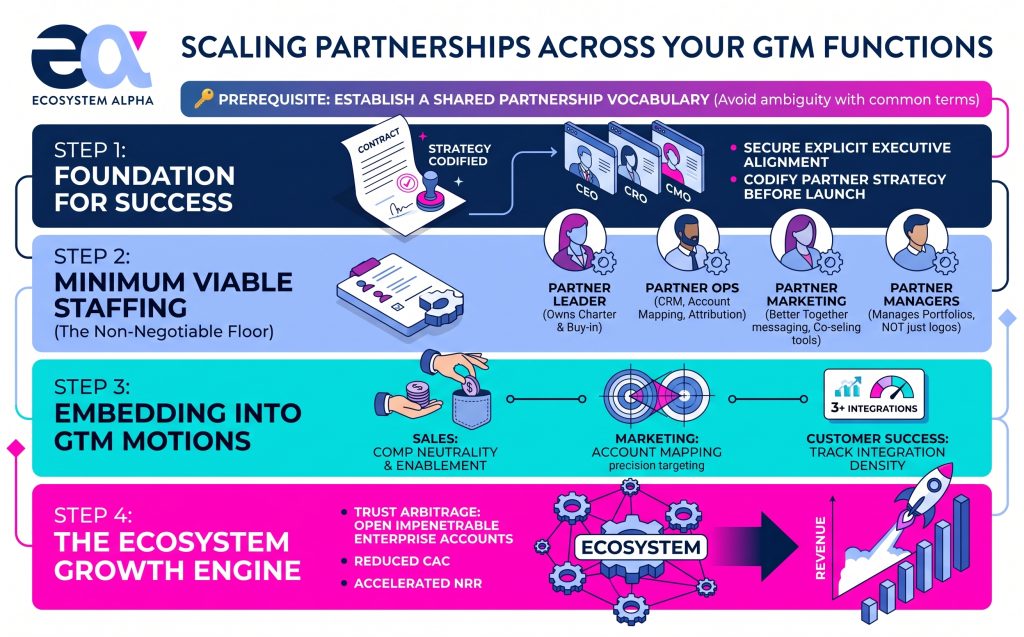
This guide explores how to build a codified partner strategy that earns explicit executive alignment, structure a team for cross-functional impact, and align sales, marketing, customer success, and RevOps to scale partnerships, turning your ecosystem into a predictable revenue engine.
Ecosystem Success Starts with a Common Understanding
When product, sales, marketing, customer success, and executive leadership operate with different definitions of what a “partner,” “channel,” or “ecosystem” actually means, strategic alignment is impossible. Having a set of clearly defined, agreed-upon terms ensures that every department is moving toward the exact same operational goals without ambiguity.
[To help your organization establish this foundational language before building your strategy, we have created a comprehensive guide to the most common partnership and ecosystem terms as a resource.]
The Case for Cross-Functional Partnerships
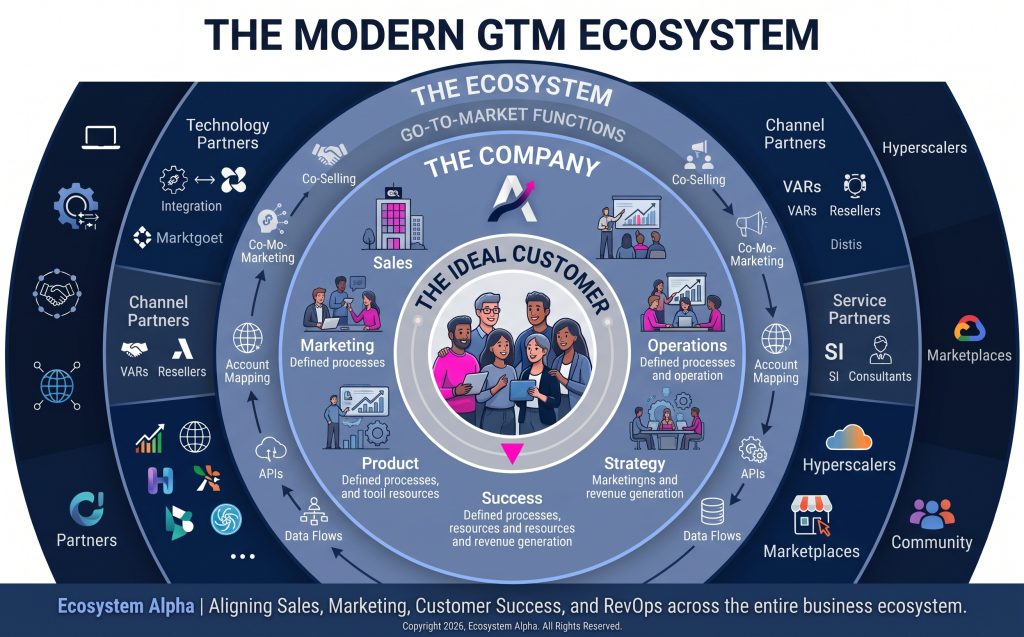
A partnership program fails when it operates in isolation from other go-to-market functions. While partnerships operating in a vacuum may generate a trickle of inbound leads, the real leverage—trust, retention, and compounding co-sell momentum—only unlocks when every go-to-market function is actively engaged.
The traditional B2B funnel-based approach is fundamentally broken. Historically, marketing generated leads, passed them to SDRs, SDRs passed them to sales, and sales passed them to Customer Success. This created multiple handoffs, inherent misalignment, and a reliance on sheer volume. Today, outbound response rates are approaching zero, cold calls are nearly impossible to convert, and the cost of digital advertising is skyrocketing.
Partnerships solve this through trust arbitrage. Partners have already built trust with the customers you want, opening doors that direct outreach cannot. However, trust is fragile. If your sales team does not know how to co-sell collaboratively, if your marketing team ignores the “better together” story, and if Customer Success treats integrations as a distraction, that trust goes to waste.
The Friction Points of an Isolated Program
When partnerships are siloed, friction points across the business become predictable:
- Sales: Sellers experience friction around compensation, worrying about losing commission when a partner is involved, and they lack the enablement required to pitch a joint value proposition.
- Marketing: Teams fail to incorporate partners into account targeting, treating partner logos as a mere afterthought on a website rather than a core campaign driver.
- Customer Success: CSMs operate with a “software-only” mindset, failing to advise the customer on where the product sits within their broader technological stack.
- RevOps: Partner operations are treated as a footnote to the sales ops function, resulting in poor data visibility and broken attribution.
When these functions align around an ecosystem strategy, companies gain access to impenetrable enterprise accounts, dramatically reduce customer acquisition costs (CAC), and drive measurable leaps in net revenue retention (NRR).
Structuring for Success: Ownership and the Team
The most foundational requirement before signing a single partner is to codify your partner strategy and secure explicit executive buy-in. Without this alignment from the CEO, CRO, CMO, and Chief Customer Officer, programs stall on internal politics instead of compounding in impact.
Executive Positioning and Org Design
In an ideal organization, the partnership leader sits at the same level as the CRO, CMO, and Chief Customer Officer. This function needs to negotiate across departments with executive authority. Without peer-level standing, partnerships will always be subordinated to whichever function they report into—optimizing for siloed metrics rather than the full ecosystem view.
If a separate C-level reporting line is not possible, reporting to the CRO is the best alternative. The CRO’s broad revenue remit makes them more open to partnerships as more than a simple referral channel. However, the person leading the function must be senior enough to present a unified strategy to peers and hold other functions accountable to it.
Minimum Viable Staffing
To run a partnerships function effectively, four roles represent the non-negotiable floor. Shortchanging any of them creates a predictable failure mode:
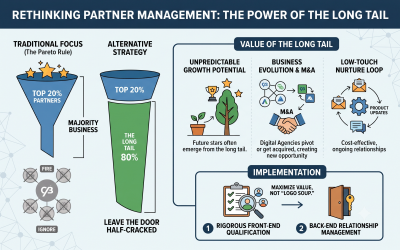
Partner Managers: These individuals own individual partner portfolios, carry revenue numbers, and build deep external relationships. Headcount here scales by improving upfront partner selection, not by accumulating massive directories of inactive logos.In partnership design, there are two danger zones that kill GTM momentum. Success lies in the middle.
Partner Leader: Owns the strategy, roadmap, and executive relationships. They set the charter, maintain C-suite alignment, and negotiate the cross-functional resources required to make partnerships successful.
Dedicated Partner Ops / RevOps: Without a dedicated seat, this person gets pulled into direct sales ops work. Partner ops owns CRM configuration, pipeline attribution, data clean rooms (like Crossbeam), and compensation tracking.
Dedicated Partner Marketing: Must be a dedicated full-time equivalent (even if they sit within the broader marketing org). They ensure the “better together” story makes it into campaigns, build joint collateral, and manage co-marketing funds.
Embedding Partnerships into Sales, Marketing, and CS
The Sales Engine: Building a Co-Sell Motion
The partnership team must mirror the cadence of the direct sales cycle, running internal pipeline and deal reviews just as sales leadership does. Will Schnabel emphasizes that the right co-sell model in mid-market to enterprise SaaS is rarely a pure reseller model. The internal seller remains the product expert and drives the sales process; the partner’s role is to open the door, provide account intelligence, and bring trust.
- The Prep Call: The critical motion change is the prep call. Before engaging the customer, the seller and partner must align on context, account history, and strategy.
- Compensation Neutrality: This is the absolute minimum requirement. If a seller earns lower compensation on a partner-sourced deal (because finance views the partner referral fee as a double cost), the seller will avoid working with partners entirely. For strategic alliances, making partner-attached deals comp-positive is a worthwhile investment given the higher win rates and larger deal sizes they generate.
- Enablement: Sellers must be trained on how to spot partner opportunities during discovery and how to tag partners appropriately in the CRM.
The Marketing Multiplier
Marketing should transition from buying cold attention to leveraging borrowed trust. The highest-leverage change marketing can make is implementing account mapping tools.
By using platforms like Crossbeam, marketing can connect your prospect lists with your partners’ customer lists. Identifying which target accounts overlap with your partners transforms cold campaigns into precision, warm outreach. Marketing must proactively build content and messaging around joint value propositions. Teams should sync monthly to stay in rhythm and align quarterly on which broader marketing themes have a partner amplification opportunity (e.g., joint webinars, co-authored whitepapers, and shared event sponsorships).
Customer Success Integration
Customer Success teams must shift from a software-only delivery mindset to an “ecosystem consultant” mindset. They should actively ask customers what other tools they are using and where your product fits in their stack.
Certified Delivery Partners: Internal CS teams should build structured apprenticeship programs for delivery/implementation partners. By shadowing partners on early implementations before offloading work, you build internal trust, set a high external quality bar, and eventually scale your onboarding capacity at a fraction of internal costs.
The Engine Room: Tech Stack, Governance, and Agreements
RevOps and the Technology Stack
A dedicated RevOps approach is required to identify and configure the right tools for the partnership function, ensuring that co-selling feels invisible and frictionless to the direct seller.
The core partnership stack includes:
- PRM / CRM Extension: The operational layer for managing partner relationships, tracking leads, and handling payouts. A Partner Relationship Management (PRM) system must plug tightly into the core CRM so data is unified.
- Account Mapping Platforms: Tools like Crossbeam are essential for overlap analysis and surfacing real-time co-sell signals. They eliminate the need for manual, insecure spreadsheet sharing.
- AI Layer: AI-driven workflows are becoming a baseline for partner acquisition research, joint value proposition development, and market analysis.
- Hyperscaler Marketplaces: For companies with significant exposure to Google Cloud, AWS, or Azure, these marketplaces should be treated as full sales operating systems, not just alternative distribution channels.
Agreements and Program Governance
When structuring agreements, simple and consistent beats comprehensive. Complex legal clauses do not change partner behavior; operational clarity does.
- Define the Mechanics: Be explicit about what qualifies as a referred lead, the attribution window (e.g., 90 vs. 180 days), and exactly when payment is triggered.
- Avoid Exclusivity: Never grant exclusivity. Exclusivity creates costly problems the moment better opportunities emerge, and no single partner will be a silver bullet for your pipeline.
- Data Security: Ensure IP and data security obligations in partner agreements mirror your standard enterprise customer contracts so that every relationship is built on trust-generating terms.
Cadence and Culling
Maintain rigorous cadences to anchor the program: weekly sales leadership syncs, monthly marketing alignment, and quarterly partner portfolio reviews (QBRs). Crucially, apply the 80/20 rule to your partner ecosystem. You must build a framework for what a good partner looks like and actively cull underperforming relationships. A willingness to fire stagnant partners separates a mature ecosystem from a bloated logo collection.
Conclusion
Pitfalls to Avoid
Even well-designed programs can stall if they fall into common traps. To ensure your ecosystem thrives, avoid these critical failure points:
- Unbalanced Reciprocity: A partnership stalls when it relies solely on the partner’s trust and access without a ‘give to get’ process. Sales teams must proactively share context, intel, or introductions to their own deals.
- Penalizing Compensation: As noted, reducing seller commission to offset referral fees is the fastest way to destroy co-sell momentum internally.
- The Shotgun Approach: Accumulating large partner directories without a clear strategic thesis results in a long tail of inactive relationships that consume bandwidth without producing revenue.
- Lack of Buy-In: Launching without cross-functional executive alignment across sales, marketing, and CS relegates the program to a mere side-project that will eventually be defunded. Secure your internal alignment before you sign your first external agreement.
The Ecosystem as a Growth Engine
Ultimately, scaling a successful partnerships program requires a fundamental shift from viewing partners as a siloed, secondary sales channel to treating your entire ecosystem as a core, cross-functional growth engine. By securing explicit executive buy-in, establishing a shared operational vocabulary, and embedding collaborative motions directly into the daily workflows of Sales, Marketing, Customer Success, and RevOps, organizations can unlock the true power of trust arbitrage. By avoiding the common pitfalls of misaligned compensation, disconnected tech stacks, and bloated logo directories, you can transform your partner network from a passive list of names into a predictable revenue engine—one that opens impenetrable accounts, drives down acquisition costs, and dramatically accelerates long-term customer retention.
About Ecosystem Alpha
Ecosystem Alpha is an advisory firm that helps B2B technology and services companies build, operationalize, and scale cross-functional ecosystem strategies designed to drive revenue, retention, and go-to-market efficiency. Built on deep operational expertise in partnership strategy, the firm provides B2B organizations with the frameworks needed to integrate partner motions directly into their core business. Through tools like the Ecosystem Alpha Assessment—a structured diagnostic to evaluate partnership readiness—and industry insights shared on the Ecosystem Alpha Podcast, the firm positions partnerships not as an isolated sales channel, but as a central, company-wide growth engine.