Essential Partnership & Ecosystem Terms Every B2B Leader Must Know
A reference guide to establishing a shared vocabulary across sales, marketing, CS, and RevOps to drive cross-functional ecosystem alignment.
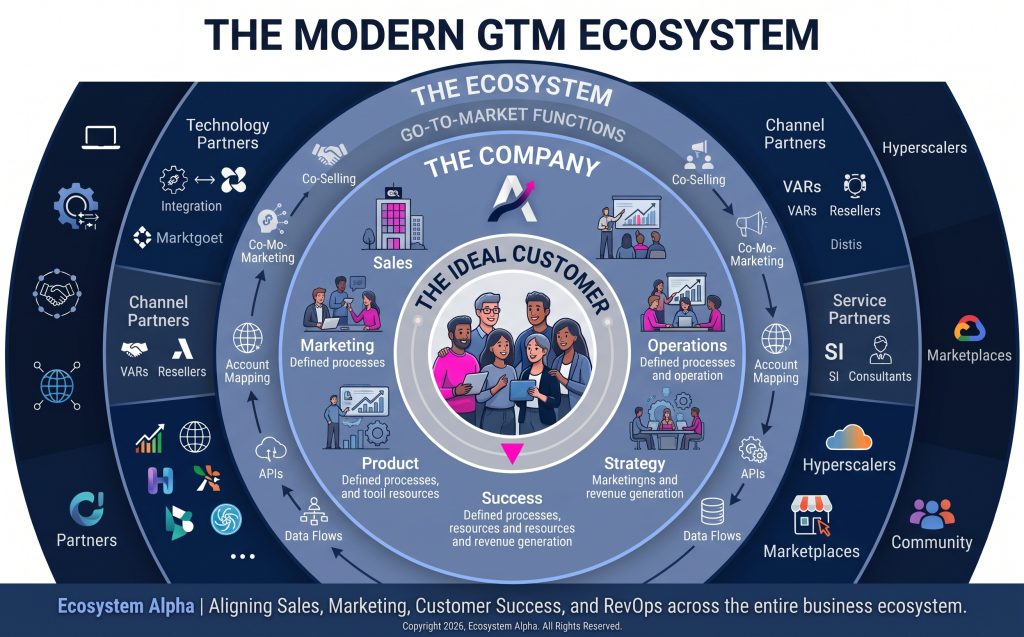
Every organization operates within an ecosystem. Whether your company actively manages them or not, networks of overlapping software tools, platforms, service providers, channel intermediaries, and industry relationships already surround your business and your customers.
An intentional ecosystem strategy is about building the core internal capabilities needed to leverage these existing relationships—turning ambient market connections into a structured motion that drives scalable growth, improves customer retention, and ultimately delivers far greater value to the end user.
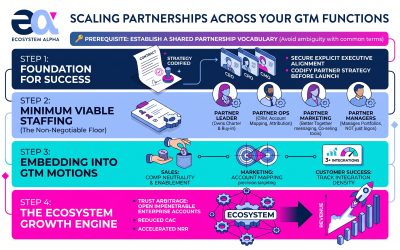
A fundamental prerequisite to building this capability and achieving cross-functional alignment across your go-to-market functions is establishing a shared vocabulary. When sales, marketing, customer success, and executive leadership operate with different definitions of what a “partner,” “channel,” or “ecosystem” actually means, strategic execution falls apart.
Having a set of clearly defined, agreed-upon terms ensures that every department is moving toward the exact same operational goals without ambiguity. To help your organization establish this foundational language, we have compiled this comprehensive guide to the most common partnership and ecosystem terms.
Core Partnership Definitions
Ecosystem-Led Growth (ELG): A modern corporate strategy that decisively prioritizes the partner network as the primary, central engine for scaling revenue, enhancing product capability, and driving customer retention.A partnership program fails when it operates in isolation from other go-to-market functions. While partnerships operating in a vacuum may generate a trickle of inbound leads, the real leverage—trust, retention, and compounding co-sell momentum—only unlocks when every go-to-market function is actively engaged.
Ecosystem: The structural network or broader environment of interconnected companies, organizations, and individuals that collaborate and depend on each other to create value and support mutual growth. Some of the strongest ecosystems are built on overlapping or adjacent use cases, workflows, and shared data that enable customers to do what was previously not possible with only one solution.
Partnerships (Partner-Led Growth): The deliberate business strategy or “growth motion” where a company leverages external entities to drive sales and revenue, rather than relying solely on direct selling efforts. This is achieved by collaborating through a myriad of options—including channel, ecosystem, referral, affiliate, reseller, and nearbound relationships.
Common Partnership and Operational Terms
- Account Mapping: The strategic, data-driven process of comparing the customer and prospect lists of two partnering organizations to identify overlapping accounts.
- Activation Rate: A highly critical operational metric that measures the specific percentage of enrolled partners who have completed a defined, value-generating action, such as executing a first sale or finishing a technical certification.
- Affiliate Partner: An individual or business participating in an affiliate program that broadly promotes a product to their audience (e.g., via a blog, newsletter, or digital ads). They typically rely on a one-to-many reach rather than deep personal relationships with the end buyer.
- Affiliate Program: A performance-based marketing initiative where a company provides tracking links, promotional assets, and a standardized commission structure for external entities to generate leads or sales.
- B2B Collaboration: A high-level strategic partnership between two organizations operating strictly within the business-to-business sector. These collaborations leverage highly complementary offerings to close specific product gaps, expand geographic reach, or co-author intellectual property.
- Channel (Channel Partners): Intermediaries who have established relationships with target customers or have expertise in specific industries or markets. They act as a distributed, external extension of a vendor’s internal sales force. Examples include distributors, value-added resellers (VARs), system integrators, consultants, and agencies.
- Channel Conflict: A highly destructive scenario where a vendor’s internal direct sales team and its external indirect channel partners find themselves aggressively competing to close the exact same client or market segment.
- Co-Marketing Orchestration: The deeply synchronized execution of comprehensive marketing campaigns by two or more allied brands. Partners pool capital, audience reach, and creative resources to produce high-value assets.
- Compensation Neutrality: A sales compensation structure where an internal sales representative earns the exact same commission on a deal regardless of whether a partner was involved or if a partner referral fee was paid by the company.
- Co-Selling: An intensive, collaborative sales motion where a vendor and a partner actively work side-by-side to close a specific enterprise deal, leveraging the partner’s localized trust alongside the vendor’s technical expertise.
- Deal Registration: A formalized, software-driven channel protection mechanism. A partner submits the details of a prospective sales lead into the vendor’s portal, and upon managerial approval, the vendor grants the partner temporary, exclusive rights to work the deal.
- Delivery Partner: A partner who is trained and certified to deliver a specific technology solution. They can also be a channel partner.
- Embedded Software: A deep integration strategy where one company licenses its core technology, engine, or API to be hard-coded directly into another company’s existing software product. To the end-user, the technology feels like a native part of the host application.
- Global System Integrator (GSI): Massive, international consulting and IT services firms (e.g., Accenture, Deloitte, Capgemini) that act as a specific type of channel partner. They specialize in handling highly complex, enterprise-wide digital transformations by combining hardware, software, and networking products from multiple vendors.
- Hyperscalers (Hyperscaler Marketplaces): Massive cloud service providers, primarily Amazon Web Services (AWS), Google Cloud, and Microsoft Azure. They are a type of Ecosystem Partner. In a mature partner strategy, these marketplaces are treated as full sales operating systems rather than simple distribution channels.
- Ideal Partner Profile (IPP): A rigorous, data-driven framework defining the specific attributes of a highly successful partner for a given vendor. An IPP incorporates firmographic data, target audience alignment, technical implementation capabilities, and business model compatibility.
- Integration Density: A Customer Success metric tracking the number of active partner integrations a customer has connected to your core product. Research shows that a higher integration density (specifically three or more) heavily correlates with a massive jump in customer retention.
- Integration Platform as a Service (iPaaS): A sophisticated suite of cloud-based services that enables the rapid development, execution, and secure governance of integration flows connecting disparate software applications without custom middleware.
- Market Development Funds (MDF): Discretionary capital allocated by a vendor to its channel partners specifically to fund localized marketing initiatives, such as hosting regional trade shows, running digital advertising campaigns, or executing lead generation efforts.
- Nearbound: The concept of working deals together through an existing network of relationships. It operates on the philosophy that your best prospects already live within your ecosystem as customers or prospects of your partners.
- Original Equipment Manufacturer (OEM): A manufacturing model where a company produces a component or finalized product entirely based on the proprietary design, blueprints, and specifications provided by the purchasing company. (Note: In SaaS, this is heavily synonymous with Embedded Software).
- Partner Relationship Management (PRM): Enterprise software platforms meticulously designed to orchestrate the entire lifecycle of an indirect sales channel, acting as the central operational hub for onboarding, deal tracking, and analytics.
- Referral Partner: An individual or entity, such as an existing customer or industry consultant, who recommends a product directly to someone they know. They rely on a one-to-one relationship and pre-existing trust to provide a warm introduction or endorsement.
- Referral Program: A structured initiative designed to incentivize existing relationships (customers, consultants, or close partners) to submit warm leads or introductions, often managed through forms or portal submissions.
- Reseller: Third-party companies or individuals who purchase products or technology from a company and then resell them to end customers, typically adding their margin to the product price.
- Second-Party Data: First-party data collected by a trusted partner that is shared securely with your organization (often via clean rooms or account mapping tools like Crossbeam). This data is used to inform joint go-to-market strategies, account scoring, and pipeline prioritization.
- System Integrators (SIs) and Global System Integrators (GSIs): A specific type of channel partner that builds complete computing solutions by combining hardware, software, and networking products from multiple vendors. They act as trusted advisors and implementation experts. Global System Integrators (GSIs) are massive, international consulting firms (e.g., Accenture, Deloitte, Capgemini) that handle highly complex, enterprise-wide digital transformations.
- Value-Added Reseller (VAR): An ecosystem partner (and type of channel partner) that purchases a core technological product and significantly enhances its intrinsic value by attaching supplementary, highly specialized services (like custom configuration or training) before resale.
- White Label: A partnership strategy involving fully built, standalone products produced by a vendor and sold to multiple retailers or partners, who simply remove the original branding and apply their own distinct logos and colors before resale.