The Revenge of the Long Tail: Why Firing Your Inactive Partners is a Mistake
While assessing your Long Tail partners, models like Pareto and Price’s Law tempt leaders to shift away from underperforming partners, cutting off valuable relationships and ignoring future pipeline. By applying a low-touch Customer Success framework to inactive yet high-fit partners, you maintain a cost-effective tether for when business models evolve, M&A happens, or timing aligns.
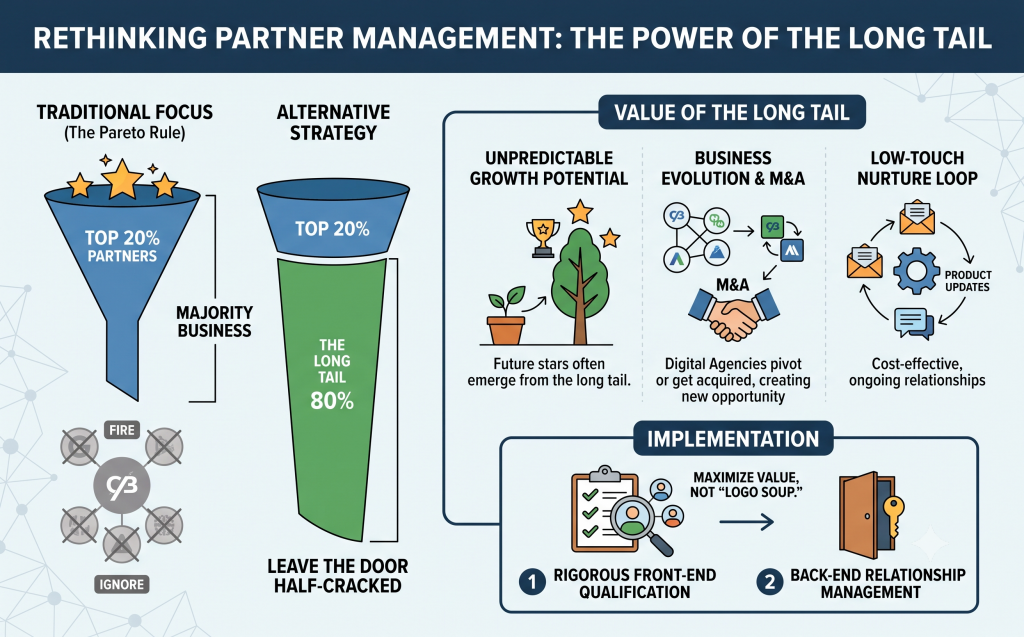
Every partner leader nowadays is well aware of the Pareto principle. You’ve heard the speech at conferences, read it on LinkedIn, and probably sat through a board meeting where someone flashed a slide declaring: “20% of your partners drive 80% of your revenue. Focus on the top tier, and cull the rest”.
Pareto, Meet Price
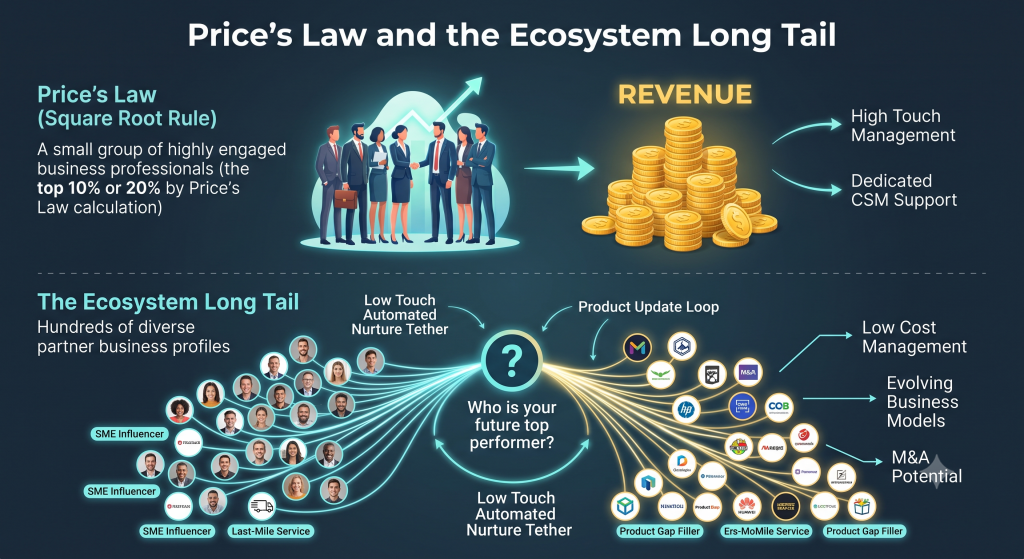
Originally derived from academia, Price’s Law states that 50% of the total output in a system is generated by the square root of the total number of participants. In partnership terms, the math gets brutal:
- If you have 100 partners, just 10 of them drive half your revenue.
- If you have 400 partners, just 20 of them drive half your revenue.
- 4X size of partner portfolio, only 2X improvement in active partnerships
Or so the theory goes. Efficiency hawks absolutely love using Price’s Law to justify hyper-focused selection of partners and partner program purges. They look at the numbers and say, “Why on earth are we wasting calories hosting a long tail of 380 partners when only 20 actually matter?”
On paper, trimming that fat sounds like peak operational efficiency. It makes spreadsheets look clean and gives the illusion of a highly optimized program.
But I think it is worth exploring a counter argument to the ‘small and targeted is better’ theory.
Treating your partner ecosystem like a corporate downsizing program ignores a fundamental truth: many of your future top-performing partners are sitting in your long tail right now.
When you completely shut the door on the other 80%, you aren’t just cutting administrative costs—you may be throwing the baby out with the bathwater. Let’s look at why leaving the door half-cracked for your long-tail partners is a competitive advantage, and how we can steal a page from the Customer Success playbook to manage it efficiently.
Borrowing from the CCO Playbook: Segmenting by Value, Not Emotion
If you want to know how to manage a massive ecosystem without losing your mind or blowing your budget, look at how a Chief Customer Officer (CCO) designs a customer strategy.
A CCO doesn’t “fire” SMB or Product-Led Growth (PLG) customers just because they don’t bring in Enterprise-level ARR. Instead, they build a cost-effective support program tailored to the level of value each segment brings:
- Enterprise Accounts: High touch, highly customized, dedicated resources.
- Mid-Market Accounts: Medium touch, supported by a mix of dedicated and shared Customer Success Manager (CSM) resources.
- PLG / SMB Accounts: Low touch, automated, tech-led, and self-service.
Experienced partner operators apply this same framework to their ecosystems.
If a long-tail partner is still the “right” fit based on your broader partner strategy—meaning they serve a target Ideal Customer Profile (ICP), fill a specific product gap, deliver critical last-mile services, or act as a key buyer influencer—then their inactivity isn’t a failure. It simply means the value exchange at this exact moment in time is low.
Instead of severing the tie and destroying a relationship, the smart play is to build a low-touch, automated tether that keeps them in your orbit until the timing is right.
Friction vs. Freedom: Making it “Easy to Do Business With”
Before managing the back end of your ecosystem, you have to look at how partners get inside in the first place. A major component of a healthy ecosystem is being Easy to Do Business With (ETDBW). If you make it incredibly difficult, painful, or bureaucratic for an organization to engage with your ecosystem, you limit the relationship before it even starts.
This starts with your legal and program frameworks. If your onboarding process requires a 40-page master services agreement and six rounds of redlines just to become a baseline referral partner, you are alienating the market. Conversely, if your agreement has zero substance, you run into operational chaos down the road. Finding that perfect operational sweet spot is critical—a concept explored deeply in The Executive Guide to Building a Scalable Partner Program: The Goldilocks Paradigm.
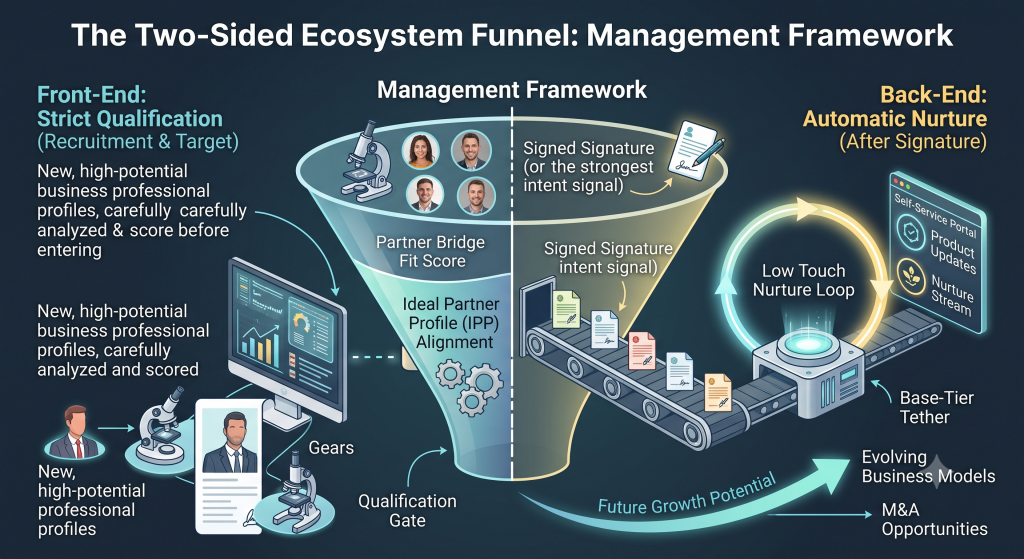
When you make your program easy to join and your baseline agreements balanced, you naturally create a broader funnel. The magic happens when a partner takes the time to sign that frictionless agreement. Even if they don’t drive revenue in the first 90 days, that signature matters. Price’s Law tells us that elite performers are rare, but you still need a wide enough “crop” of signed partners to discover who those top performers will actually be.
The Front-End vs. Back-End Partnership Framework
I am absolutely not advocating for “logo soup”—that vanity metric where a company brags about having thousands of logos on their partner page while knowing they don’t have the internal headcount to support them or not truly making a revenue impact to the business.
That’s just smoke and mirrors.
Instead, experienced operators look at the ecosystem as a front-end and back-end problem:
The Front End (Strict Qualification)
You should be highly scientific about who you target and proactively recruit. Use modern ecosystem technology like PartnerBridge to rigorously assess fit, score alignment against your Ideal Partner Profile (IPP), and analyze mutual data to catch mismatches before you spend heavy resources onboarding them.
The Back End (The Long Tail Nurture)
Once a partner is through the door and has taken the effort to sign an agreement, the rules of engagement shift. Even if they go quiet, they shouldn’t be deleted. Instead of “firing” them, transition them into a low-touch, low-cost nurture loop (our version of the PLG customer track) that keeps them warm without draining your partner managers’ time.
3 Reasons the Long Tail is a Goldmine in Disguise
Why spend even a single calorie keeping an inactive partner on life support? Because businesses, ecosystems, and human beings are dynamic. They don’t stand still.
1. Partners Evolve (and Get Acquired)
A digital agency or boutique consultancy that wasn’t a good fit for you last year might pivot its business model entirely this year. Even more common in the agency world is consolidation.
That quiet, inactive long-tail partner could get acquired next month by a massive global system integrator or a dominant regional player. If you maintained a respectful, professional, value-add relationship with them during their quiet phase, you suddenly have a warm, trusted foot in the door with the larger organization that just bought them.
2. A Signed Contract is the Ultimate Intent Signal
In marketing and sales, organizations spend millions of dollars tracking digital “buyer intent signals”—webinar attendance, whitepaper downloads, or website clicks. Yet, partner operations teams routinely throw away the strongest intent signal of all: the fact that a human being at another organization once put pen to paper and signed a legal agreement to work with your company.
Advanced data models and AI have a notoriously difficult time identifying personal human desire, internal corporate politics, and true executive sponsorship. That historical signature represents real, human intent. They may have had just one specific client use-case at the time, or simply a personal desire to learn your technology. Underestimating that foundational interest is a massive missed opportunity.
3. The “Direct Downgrade” Sparks Magic
When companies audit their partner tiers, the default reaction is to quietly turn off portal access or send a cold, automated breakup email. Ghosting partners or abruptly shutting them off destroys trust and burns bridges in the community.
Instead, try being completely upfront and direct. Reach out periodically to your inactive cohort with an honest message:
“Hey, we notice you haven’t been active in the program lately, and we know how busy things get. To keep expectations aligned, we are moving you from our active tier to our base-tier growth (nurture/referral) program. You’ll still get product updates and keep your baseline access, but without any production thresholds.”
You’d be amazed at how many partners pop their heads up and say, “I’m so glad you reached out. Things have been crazy over here, but I actually have a client right now who needs your tool and I’ve been meaning to re-engage.” It creates an organic, respectful touchpoint that frequently breathes life back into dead accounts.
Lessons from the Field: The 500-Partner Pivot
The power of managing this long-tail transition with transparency works at scale. In a previous role, our team had to transition a thriving, massive base of 400 to 500 legacy partners into the much larger, more structured IBM ecosystem.
According to Price’s Law, roughly 22 of those partners should have been driving half the value. It would have been incredibly easy to look at the other 478 partners, assume they wouldn’t survive the migration, and simply cut them loose.
Instead, we chose to be completely forthright. We laid out the changes directly, explicitly sharing the pros and the cons of what the new program structure would look like.
Did everyone love it? Absolutely Not. Change always ruffles feathers, and some partners were unhappy. But a strong portion of those long-tail partners looked at the new structure, identified unique advantages that aligned with aspects of their business models we weren’t even aware of, and pivoted successfully. They ended up accelerating their relationship with us within the new ecosystem, turning into key contributors because we chose to communicate rather than delete them.
The Bottom Line: Keep the Door Half-Cracked
Focusing your primary human energy, co-marketing dollars, and dedicated partner managers on your top tier partner is smart, defensive partnership management. But keeping your long tail alive via an automated, low-touch, product-update nurture stream is also a highly viable offensive strategy.
Price’s Law correctly highlights how hyper-concentrated success is at the top of an ecosystem. However, it shouldn’t be used as an excuse to burn your farm system. It costs exponentially less to keep an inactive partner warm via a low-touch channel than it does to go out into the wild, spend marketing budget, recruit, and onboard a brand-new partner from scratch.
Make it easy for them to do business with you on the way in, use technology to be rigorous about who you actively resource on the front end, and never underestimate the nuggets of gold hiding quietly in your long tail.