From Good to Great: How to Build a Disciplined, Measurable Partnership Capability
How the principles of Good to Great translate into a measurable, repeatable partnership operating system.
Jim Collins spent five years and a small army of researchers answering one question: why do some companies leap from good to great while others, with the same talent and the same market, stay average forever.
His answer, laid out in the classic business blueprint Good to Great, made a lot of executives uncomfortable. It wasn’t a miracle product. It wasn’t a hero CEO. It was disciplined people doing disciplined things inside a disciplined system, pushing a flywheel until momentum did the work for them.
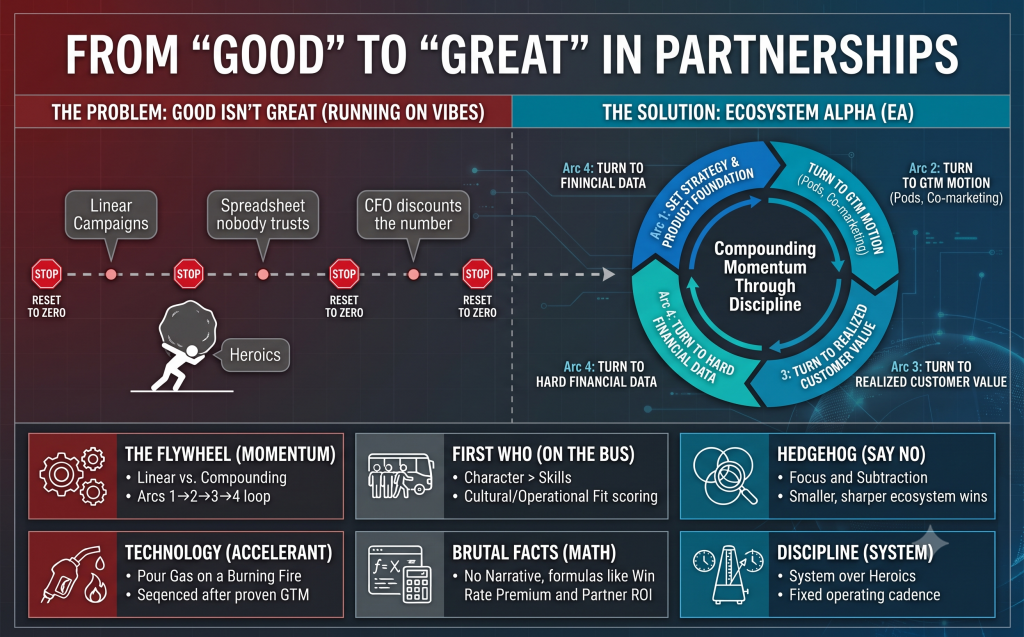
Partnerships never got that reckoning. Most partner orgs today are still running on the business equivalent of vibes: a few good relationships, a spreadsheet nobody trusts, and a CFO who’s learned to discount whatever number the partnerships team walks in with.
Ecosystem Alpha (EA) is what happens when partnerships finally get the Collins treatment. Not a metaphor. An operating system, built mechanic for mechanic against the framework that already proved this works.
1. The Flywheel: Momentum or Nothing
Collins’ whole thesis in one line: there is no single push that creates greatness. There’s only the wheel, and whether you’re turning it in a circle or dragging it in a line.
Most partner programs drag it in a line. Recruit a partner, run a campaign, close a deal, and start completely from zero on the next one. No memory. No compounding. Just repetition dressed up as strategy.
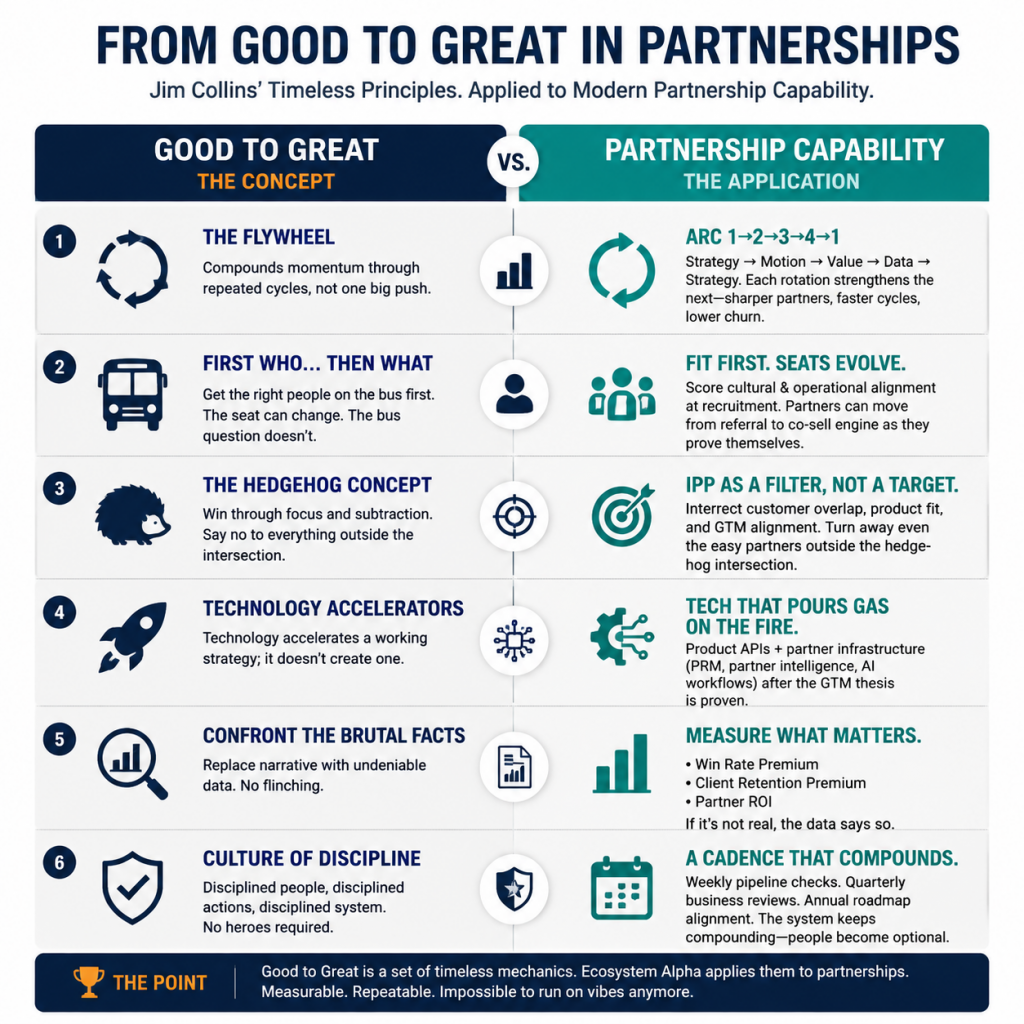
EA kills the line. Four arcs, wired into a loop that doesn’t let anything reset to zero:
- Arc 1 sets the strategy and the product foundation.
- Arc 2 turns it into GTM motion — programs, co-marketing, co-selling.
- Arc 3 turns motion into realized customer AND partner value.
- Arc 4 turns value into hard financial data — and helps inform next cycle in Arc 1.
Every rotation makes the next one cheaper and faster. Sharper partner profile. Deeper integrations. Shorter sales cycles. Lower churn. This is the exact compounding logic Collins found at Kroger and Gillette — just pointed at an ecosystem instead of a single P&L.
2. First Who… Then What: The Bus Doesn’t Care About Your Deck
Here’s the part of Good to Great everyone quotes and almost nobody actually applies: get the right people on the bus first. Skills can be taught. Character can’t. A brilliant résumé attached to someone who isn’t bought in is still, in Collins’ words, the wrong person on the bus.
Most partner programs skip this entirely. They recruit against a checklist — logo size, market overlap, integration compatibility — and never ask whether the two organizations can actually stand to work together.
EA asks it anyway, as a hard scoring dimension applied at recruitment, right alongside strategic fit: operational tempo, internal champion strength, real executive trust, functional teams that don’t need a translator to talk to each other. That’s the bus question. It gets answered once, and it stays fairly settled.
What Collins also said — and what gets dropped from every LinkedIn post that quotes him — is that seats move. The right people get re-seated as strategy evolves; the wrong people get removed. EA builds that in explicitly: a partner’s tier, pod, and GTM motion are designed to expand or contract as the relationship proves itself, without ever reopening the bus question. A partner can start as a narrow referral and grow into a full co-sell engine. The seat changes constantly. Whether they belong on the bus doesn’t.
Score fit and cultural alignment together, and you stop making the mistake every volume-driven program makes:
| Low strategic fit | High strategic fit | |
|---|---|---|
| High cultural alignment | Emerging — smaller fit, real conviction. Give them a seat and watch what happens. | Ideal partner — invest everything. |
| Low cultural alignment | Deprioritize — doesn’t get on the bus. | At risk — perfect on paper, no trust underneath. Fix that before you activate anything. |
That top-left box is the one every checklist-driven program throws away. It’s also the one Collins would have kept.the smart play is to build a low-touch, automated tether that keeps them in your orbit until the timing is right.
3. The Hedgehog Concept: Say No More Than You Say Yes
Collins’ hedgehog isn’t about doing more. It’s about finding the one narrow intersection — best in the world, drives the engine, genuinely committed — and having the spine to ignore everything outside it.
Most partner orgs measure success by ecosystem size. More logos, bigger directory, better-looking slide for the board. EA thinks that’s the wrong scoreboard entirely. The Ideal Partner Profile isn’t a wishlist — it’s a filter, and its whole job is to say no. Partners outside the intersection of customer overlap, product fit, and GTM alignment get turned away, even the easy ones. Especially the easy ones.
A smaller, sharper ecosystem beats a bigger, softer one every time revenue actually gets measured.
4. Technology as Accelerant, Never the Origin Story
Collins found something counterintuitive: the companies that made the leap never used tech to manufacture momentum out of nothing. They used it to pour gas on a fire that was already burning.
This cuts two ways in partnerships, and most companies get both wrong. First, your own product — APIs, sandboxes, docs, MCP capable — built to accelerate a “better together” story that’s already proven, not to fake one that isn’t. Second, the tech stack that runs the partnership itself: PRM systems, partner intelligence, AI-driven account mapping. Buy that stack before your GTM motion actually works, or your processes are defined, and all you’ve built is a very well-organized way to watch something fail in real time.
Tech doesn’t start the flywheel. Especially with the hype around AI. It’s not supposed to. If you’re leaning on it to, that’s the tell that the strategy underneath was never real.
5. Confront the Brutal Facts: Kill the Vibes, Show the Math
The Stockdale Paradox: total confidence you’ll win, combined with zero tolerance for lying to yourself about where you actually stand. Companies that flinched from the brutal facts never made the leap. Ever.
Partnerships have run on flinching for decades. “Relationship health.” “Partner-influenced revenue” that nobody can trace to an actual dollar. Every CFO has learned to nod politely and discount the number by half.
EA doesn’t let you flinch. It replaces the story with formulas a finance team will actually defend:
- Win Rate Premium — co-sell win rate minus direct win rate
- Client Retention Premium — the lift in retention when a customer is integrated or delivered by a partner
- Partner ROI — realized revenue net of program cost
If a partner type isn’t producing a real premium, the data says so immediately, out loud, and sends you back to Arc 1 to fix it. No narrative. No benefit of the doubt.
6. Discipline Instead of Heroics
Collins: a real culture of discipline means you no longer need a hero to hold the thing together. Disciplined people, disciplined actions, disciplined system — nobody has to be a legend for it to work.
Most partner orgs are one resignation letter away from collapse, because the whole motion runs on one or two people’s personal relationships. That person leaves, the pipeline leaves with them.
EA replaces the hero with a rhythm that doesn’t care who’s in the seat: weekly pipeline checks, quarterly business reviews, annual roadmap alignment. The system keeps compounding. The individual becomes optional.
The Mechanics, Side by Side
| Good to Great Mechanic | What It Actually Does | EA’s Equivalent Mechanic |
|---|---|---|
| The Flywheel | Compounds momentum through repeated cycles, not one big push | Arc 1→2→3→4→1 closed-loop model |
| First Who… Then What | Right people first — the seat evolves as strategy does | Cultural/operational alignment score decides who’s on the bus; Dimension 3 pod placement and Dimension 7 tier advancement are the seat |
| The Hedgehog Concept | Wins through focus and subtraction, not expansion | IPP as a qualification filter, not a recruitment target |
| Technology Accelerators | Speeds up a working strategy; doesn’t create one | Product APIs plus partner infrastructure (PRM, partner intelligence, AI workflows), sequenced after the GTM thesis is proven |
| Confront the Brutal Facts | Replaces narrative with unavoidable data | Win Rate Premium, Client Retention Premium, Partner ROI |
| Culture of Discipline | Removes dependency on individual heroics | Fixed tactical/operational/strategic operating cadence |
The Point
Good to Great proved greatness is mechanical, not magical — a set of disciplines, repeated, compounding. Partnerships never got that treatment. They’ve run for thirty years on relationship heroics, vanity metrics, and a CFO who’s stopped believing the numbers.
Market leadership belongs to organizations that build scalable, compounding systems. Ecosystem Alpha is what that looks like for partnerships — not a metaphor borrowed from a business classic, but the same operating physics, finally applied to a discipline that’s never had them. Measurable. Repeatable. Impossible to run on vibes anymore.