Program-as-a-Product: Why Your Partner Program Needs a PM, Not Just a Deal-Maker
Stop Running Your Partner Program Like a Side Project. Start Running It Like a Product.
Most B2B companies eventually hit a wall with direct sales alone. The natural next move is to build an ecosystem — a network of partners who extend your reach and multiply your revenue. But here’s the uncomfortable truth: the vast majority of partner programs never deliver predictable ROI.
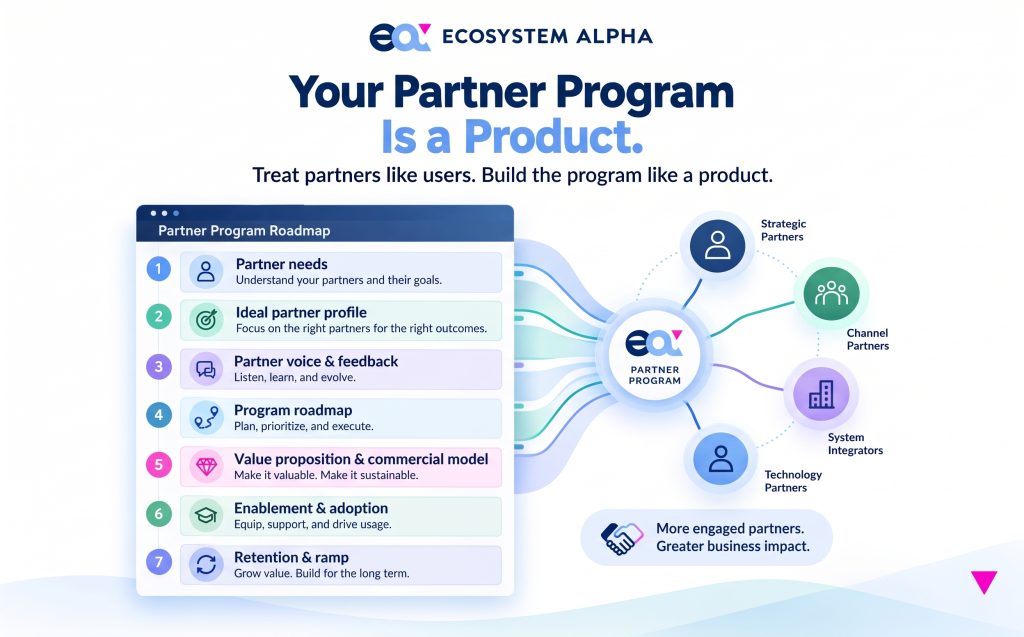
The problem isn’t partner motivation. It’s that most GTM organizations treat their partner program as an administrative afterthought rather than what it actually is: a product. And partners aren’t line items to manage. They’re customers to win.
This isn’t just a metaphor. It’s an operating discipline — and it starts with a claim that should reshape how you staff and run your ecosystem team: your program architecture is your product architecture. The same structural thinking that goes into designing a SaaS platform — tiers, gating logic, value exchange, technical scaffolding — belongs in the design of your partner program. And the person running that program needs to think like a Product Manager, not a deal-maker.
The Mental Shift: Partners Are Customers, Programs Are Products
When you build software, you don’t ship features on a hunch. You research user needs, define a value proposition, architect the system, and track adoption. Partner programs deserve the same discipline.
- The customer is the partner. You’re competing for their attention and investment, just like you compete for buyers.
- The product is the program. Tiers, MDF, training, and co-selling infrastructure are your feature set.
- The value exchange is margin and growth — not just what you get from the relationship, but how efficiently your partner can build a business around you.
If some of this terminology is new — IPP, VoP, advancement currency — our glossary of essential partnership and ecosystem terms is a useful companion to this piece.
There’s a piece of this that’s easy to skip past: a value proposition isn’t just what you give a partner — it’s also what it costs them to participate. Time, resourcing, exclusivity commitments, certification effort, the opportunity cost of representing you instead of (or alongside) someone else. A product pricing page is honest about both sides of that equation. A partner program should be too. If you can’t articulate what you’re asking of a partner as clearly as what you’re offering them, the value exchange isn’t actually defined yet — it’s just a list of perks.
Program Architecture Is Product Architecture
Here’s where the analogy stops being a nice metaphor and becomes a literal design method. Good software isn’t a pile of features — it’s a system organized into deliberate architectural layers, each answering a different question. A mature partner program has that exact same structure. It just isn’t usually described that way.
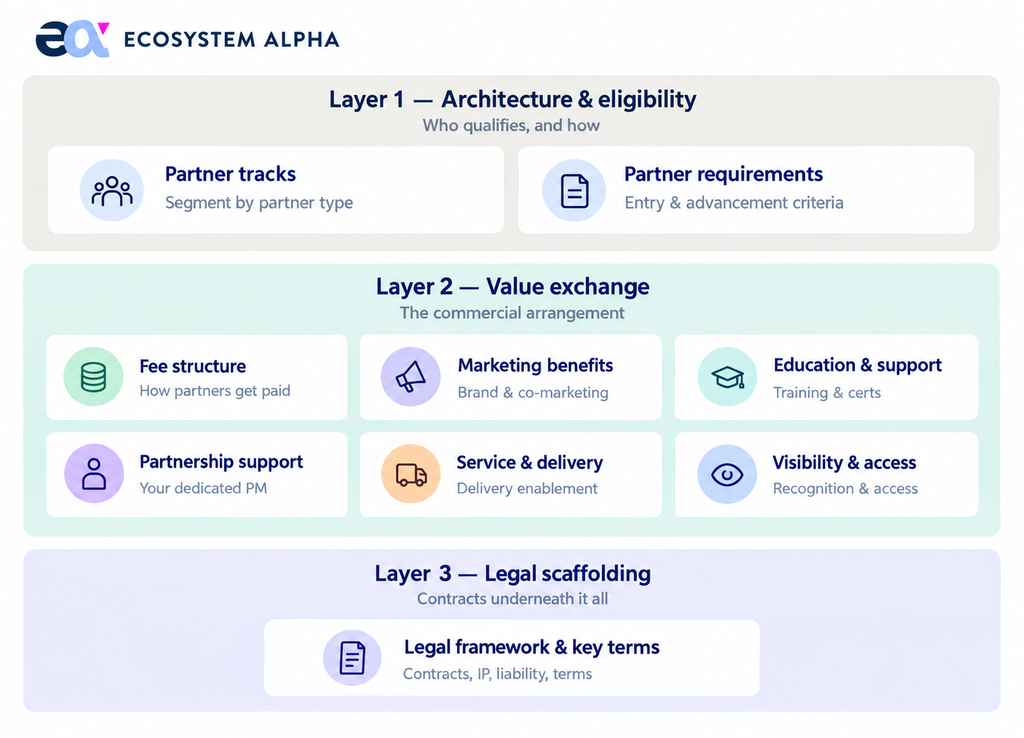
Think of your program as software with three architectural layers:
Layer 1 — Architecture & Eligibility (the gate). Just as a product defines its user roles, permissions, and onboarding flow, your program needs to define who qualifies and how. This is where you decide your Partner Tracks (do System Integrators, ISVs, and Resellers need fundamentally different ladders, or one ladder with tiers?) and your Partner Requirements — the entry criteria and the “advancement currency” that moves someone up a level. Choose that currency carefully: whatever you measure — sourced revenue, certifications, platform usage — is the behavior you’ll get more of. That’s a product decision, not an HR one.
Layer 2 — Value Exchange (the commercial arrangement). This is your feature set: Fee Structure, Marketing Benefits, Education & Support, Partnership Support, Service & Implementation, and Visibility & Engagement. Exactly like a SaaS pricing page, every tier jump should unlock something coherent across multiple categories — not just a bigger commission number. A tier bump that only changes the payout percentage is a pricing tweak, not a product upgrade.Fee structure also varies in a more basic way across partner types: in some models the vendor pays the partner (affiliates, ISVs, agencies), and in others the partner pays the vendor (marketplaces, resellers, OEM). Vendor-pays models compensate partners for generating pipeline or delivery capacity; partner-pays models are partners buying distribution, inventory, or licensing rights. It’s worth knowing which one you’re designing before you get into the specifics of your fee structure.
Layer 3 — Legal Scaffolding (the technical infrastructure underneath). This is the unglamorous but load-bearing layer — IP terms, liability, data handling, termination. Critically, it doesn’t scale with tier the way Layers 1 and 2 do. It scales with entanglement: how deeply the partner touches your product, your customers’ data, or your liability exposure. A low-touch affiliate needs almost none of it. An OEM embedding your technology inside their product needs the full weight of it, even if you only have one such partner. Product leaders will recognize this instinctively — it’s the same reason a simple integration needs a lighter security review than a deep data-sharing pipeline.
None of these three layers works in isolation from the rest of the business, either — a program built in a GTM silo tends to stall regardless of how well-designed its tiers are. This point gets its own treatment in our executive guide to scaling partnerships across GTM functions.
Partner Experience Is a Design Problem, Not an Afterthought
Products live or die on user experience — how easy something is to try, to onboard into, to get value from quickly. Partner programs have the identical dynamic, and it deserves to be treated as its own design problem rather than a side effect of good intentions.
Ask the same questions a product team asks about onboarding flow, just pointed at partners: How easy is it to acquire — to find the program and understand if it’s worth joining? How easy is it to onboard — to go from signed agreement to actually operational? How quickly can a partner get to their first real value — their first co-sold deal, their first successful implementation?
That last question is the partner-side equivalent of time-to-value, and it deserves to be measured and optimized on its own, not folded into a broader efficiency argument. A partner who takes six months to close their first deal is a partner who’s evaluating whether the relationship was worth the investment — long before you’re evaluating whether they were worth it. Good programs treat the ramp period as a designed experience: what does a partner need in week one, month one, quarter one, and how does the program actively shorten that runway rather than assuming a partner will figure it out. Jon Mead talks through exactly this on the podcast — using predictive data to close what he calls the activation gap, rather than leaving ramp-up to chance.
Why Partner Leaders Need to Think Like Product Managers
This architecture doesn’t design itself, and it definitely doesn’t get maintained by a spreadsheet of custom deals. It requires someone running the program the way a PM runs a roadmap.
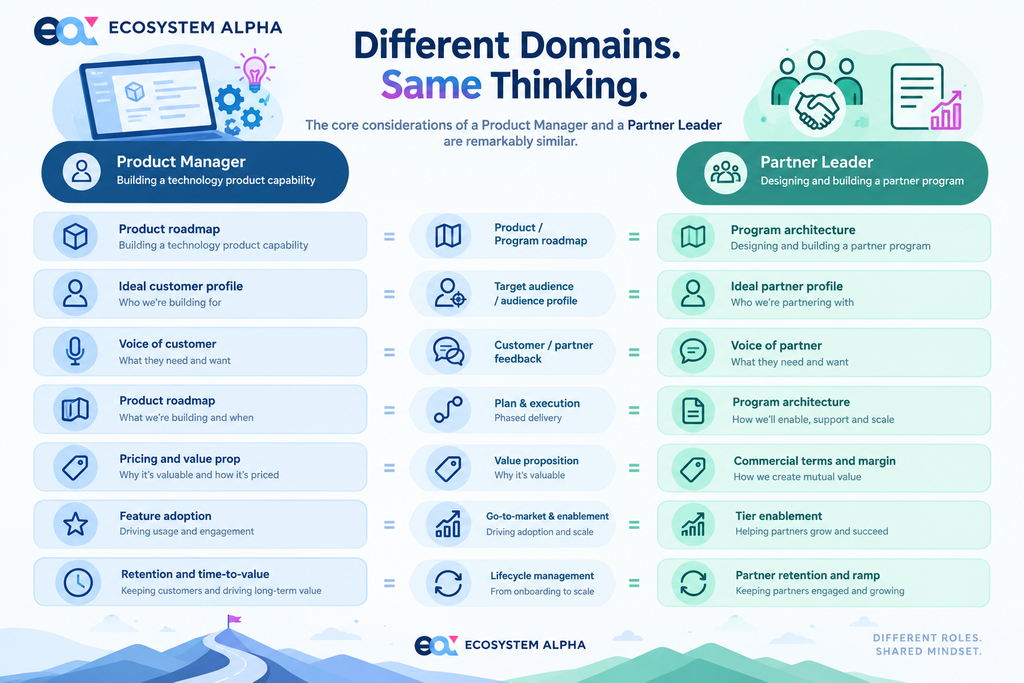
A PM doesn’t build features on a hunch — they run discovery first. Before writing a line of code, product teams sit down with users to understand pain points and workflows. Partner leaders need to do the identical thing through Voice of Partner (VoP) research: structured 1:1 interviews with target partner segments before a single tier or portal feature gets designed. And the discipline here is specific: ask how partners define value, not how you’d explain your value to them. Those are different questions, and it’s easy to accidentally run the second one while thinking you’re running the first. Ask how they price their own services, what makes a partnership genuinely valuable on their terms, and where operational friction actually lives. Skip this and you build enablement materials and portals nobody uses — the partner-program equivalent of shipping a feature no user asked for.
A PM prototypes before scaling. Don’t spec out elaborate tiers and certification tracks in a vacuum. Recruit two or three strategic partners to pilot the model based on your VoP findings, test commercial terms and co-selling mechanics manually, and only codify what actually works into the core program. That’s a beta, not a launch. You wouldn’t build a full feature set before a handful of beta customers proved it had value — the same restraint applies to building a program before a handful of pilot partners prove the model works.
A PM segments the market instead of applying one blanket motion. This is the real payoff of thinking architecturally: not every partner type needs the same depth on every pillar. A framework built around six real-world partner archetypes — Affiliate, ISV/tech partner, Agency/SI, Marketplace/hyperscaler, Reseller/MSP, and OEM — makes this concrete. An affiliate program needs almost nothing on legal scaffolding or service delivery. An OEM relationship needs heavy investment there, but deliberately minimal marketing visibility, because the whole point of an OEM deal is that your brand stays invisible to the end customer. A PM would call that intentional scoping. A generalist salesperson might mistake it for an underbuilt program.
A PM treats “done” as a myth. SaaS products evolve through continuous telemetry and user feedback. Programs need the same loop: partner advisory boards, adoption metrics (portal usage, MDF drawdown, certification completion), and quarterly iteration on the architecture itself — not just the incentive numbers.
This is why the strongest partner leaders increasingly come from Product Marketing and Customer Success backgrounds rather than purely sales. PMMs bring the research rigor to run VoP discovery and translate it into a value proposition. CS leaders bring something just as specific: they’re used to thinking of their customer’s growth as the metric that matters, and that instinct maps directly onto partner management — from the partner’s seat, their partners are effectively their customers, and the same discipline of driving continuous adoption and expansion applies. This staffing shift tracks with a broader trend: Chief Partner Officer is now one of the fastest-growing titles in the C-suite, and the leaders succeeding in it tend to be the ones who came in with product instincts rather than pure sales ones. And because partner enablement increasingly depends on real product capabilities — APIs, multi-tenancy, portal infrastructure — treating the program as a product also forces the GTM and R&D organizations to finally sit at the same table.
The Real Cost of Skipping the Architecture
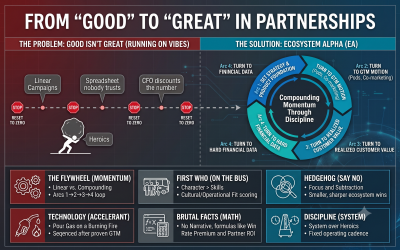
Every growing ecosystem hits the same trap: bespoke agreements, one-off incentive structures, and custom SLAs negotiated partner by partner. It feels responsive in the moment. Structurally, it’s the same mistake as writing custom code for every enterprise client — it racks up organizational GTM debt instead of technical debt, and it’s just as expensive to unwind. Our Good to Great framework for partnerships covers this same trap from the metrics side — what it looks like when a program is still running on vanity numbers and individual relationships instead of a repeatable capability.
A programmatic architecture buys you two things a pile of custom deals never will:
Faster Time-to-Value. A well-engineered program shortens a partner’s path to their first deal — the channel equivalent of product onboarding — because the architecture, not improvisation, is doing the work.
Scalability. Repeatable onboarding and transparent tiering let you manage hundreds of partner relationships with the same operational efficiency a well-architected product manages thousands of users.
Bottom Line
If channel revenue isn’t scaling, the issue usually isn’t your partners’ willingness — it’s your program’s architecture. Treat that architecture with the same rigor you’d demand of a product roadmap: layered, deliberately scoped by partner type, grounded in direct discovery, and never treated as finished. Staff it with people who think like builders, not just closers. Do that, and fragmented partner relationships turn into a repeatable, high-margin growth engine.
For a companion take on this same problem — how much structure is enough without over-engineering it — see our executive guide to building a scalable partner program, the Goldilocks Paradigm.
About Ecosystem Alpha
Ecosystem Alpha is an advisory firm that helps B2B technology and services companies build, operationalize, and scale cross-functional ecosystem strategies designed to drive revenue, retention, and go-to-market efficiency. Built on deep operational expertise in partnership strategy, the firm provides B2B organizations with the frameworks needed to integrate partner motions directly into their core business. Through tools like the Ecosystem Alpha Assessment—a structured diagnostic to evaluate partnership readiness—and industry insights shared on the Ecosystem Alpha Podcast, the firm positions partnerships not as an isolated sales channel, but as a central, company-wide growth engine.