Building Brand Equity, Regional Ecosystems, and Media Alliances for APJ Market Entry

By Sebastian Hoelzl,
Partner strategies stall for a reason that has very little to do with partners. When the ideal customer profile stays vague, every channel bet and every joint selling motion lands slightly off target. Here is how to find the root cause, and how to fix it before you spend another dollar.

Software companies keep entering Asia Pacific and Japan the same way. They hire two reps in Sydney, open a hub in Singapore and wait for pipeline. Then the numbers disappoint, so the region gets written off as difficult. However, the commercial question underneath is simple. How do you earn enough trust to sell across 33 countries when almost nobody has heard of you? Carrie Mott has answered that question inside Gartner, IBM, Salesforce, PagerDuty, Dynatrace and FullStory. Her answer starts with the customer, runs through local partners, and ends with proof you can film.
One region on the slide, 33 markets in reality
Treating APJ as a single theatre is the first expensive mistake. The region carries two thirds of the world’s population across 33 countries with different rules, different digital maturity and different internet access. Australia sits close to the land mass of the United States, yet it holds about 26 million people. Singapore holds under four million, and fewer than one million of them work in professional roles. As a result, land size tells you almost nothing about how to sell.
The differences run deeper than demographics. Japanese enterprises route large technology contracts through third party organisations, because those companies structure themselves differently. Korea sits a short flight away and works nothing like it. Singapore anchors ASEAN, which is itself five separate countries. India operates on another scale again. So there is no APJ union, no shared legislation and no single playbook. Vendors who copy the North America motion into this region therefore spend more to learn less. Mott puts it plainly. No one wants APJ to be different, but it is.
Be interested before you try to be interesting
Mott learned her craft in psychological science before she ever sold software. That training produced a rule she has repeated for decades. You have to be interested to be interesting. In practice, it means you cannot solve a customer problem with a product pitch. First you articulate their pain, their alternatives, the cost of doing nothing and everyone involved in the decision.
Her second idea explains why ecosystems now matter more. Trust has become distributed. Infrastructure runs from storage through middleware to customer experience, so dozens of people own a slice of the outcome. Buying groups have grown, procurement and finance have joined, and sales cycles have stretched. At the same time, content is cheap to generate, which means buyers discount volume and look for peers instead. Because trust sits with peers and partners rather than vendors, the space between companies becomes the valuable part. Mott designs for a three way win. The vendor wins, the partner wins and the customer wins, or the motion stalls.
Run the region as your innovation zone
The practical move is to treat APJ as a place to test, not a place to copy. Teams are leaner there, so marketing, sales development, sales engineering, sales and partners already work closely together. That density makes experiments cheap and fast. Revenue exposure stays small, so a failed test does not damage the number. Mott therefore recommends short cycles. Run the play, report the result honestly, then fund what works.
Her single highest value play is the anchor customer voice video. Over the past ten years she has filmed more than one hundred multi stakeholder customer success stories. Each one carries local proof of return, which travels further in a market that has never heard your brand. Will Schnabel funded exactly that series with Mott out of a partner budget, and he calls it the most valuable thing the team did. Two strong stories, he argues, give you more reach than twenty weak ones. By contrast, pairing two logos on a co branded campaign rarely tells the customer anything, and sales development teams are left guessing who follows up.
What the infographic shows
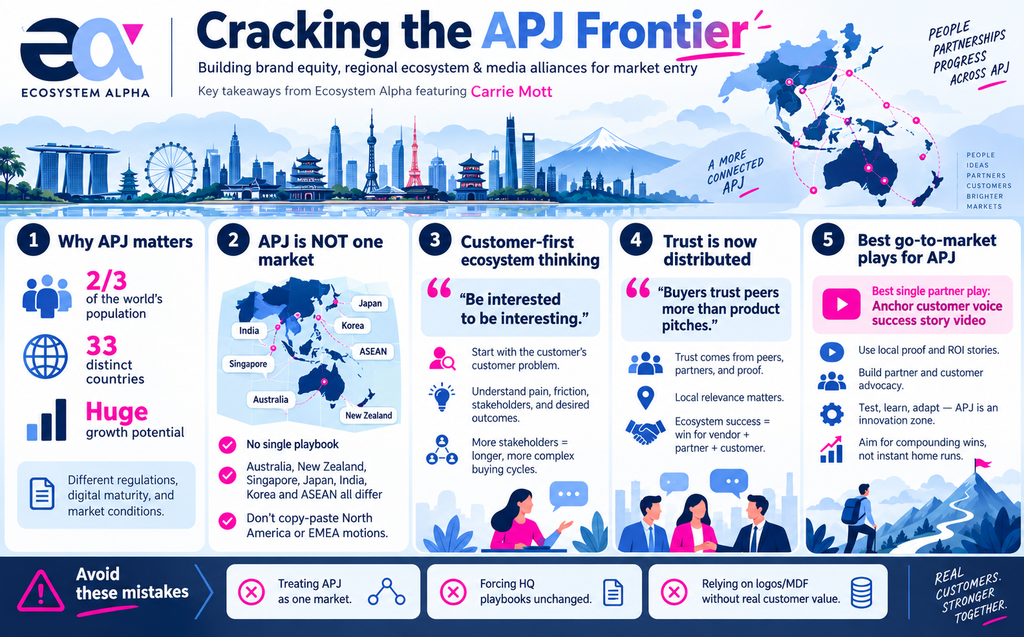
The infographic below pulls the episode into one view. It covers why APJ matters commercially, why the region behaves as 33 distinct markets, what customer first ecosystem thinking looks like in practice, how trust has moved to peers and partners, and which go to market plays work first. A final band lists the three mistakes that cost entering vendors the most money.
The bottom line
Market entry in Asia Pacific and Japan rewards trust built locally, not headcount shipped in. So start with the customer problem, borrow credibility from partners and local media, and capture proof on video before you scale spend. Mott makes the commercial case in full on the episode, including the metrics she would and would not hold ecosystem programmes to. Listen to the conversation on the podcast page, then pick one market and one story to test.
About the guest
Carrie Mott is Founder and Managing Director of Flywheel Marketing, which she launched in 2023. She leads growth work for global technology organisations and SaaS scaleups across Asia Pacific and international markets. Before founding the firm, she ran marketing for Asia Pacific and Japan at FullStory, Dynatrace and PagerDuty, and she led marketing for Asia and India at Salesforce. Earlier she ran exhibitions at Gartner and business partner ecosystems at IBM, and she has lived and worked in Shanghai and Singapore.The bottom line
⭐️ Leave a Review: If you enjoyed this episode, please follow Ecosystem Alpha on Spotify and leave us a 5-star review! It helps us bring more incredible guests onto the show.