Feedback is a Gift: Why the Best Partner Programs Are Built on Radical Listening
Why the best partner programs are built on radical listening, proactive escalations, and a multi-modal Voice of Partner strategy.
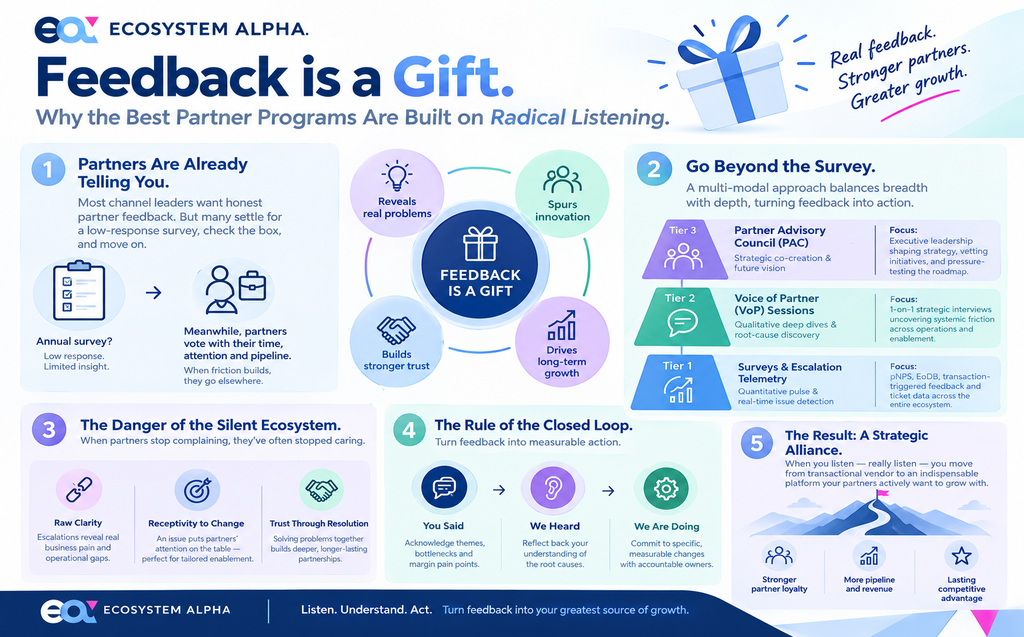
Most channel leaders say they want honest partner feedback. Yet most settle for an annual, low-response satisfaction survey, check the box, and move on.
Meanwhile, partners vote with their time, attention, and pipeline. When friction builds and nobody is listening, they quietly direct their deals toward vendors that are simply easier to do business with.
If you treat your partner program as a product—which it is—you quickly realize a fundamental truth: you cannot build a compelling product without staying intimately close to the end user. In your ecosystem, the partner is that user.
Just as product organizations rely on rigorous Voice of Customer (VoC) methodologies to drive retention and adoption, ecosystem leaders must embrace a systematic Voice of Partner (VoP) discipline.
Feedback isn’t a critique to survive or an administrative chore to run once a year. Feedback is a gift. It is the raw material required to move your partner organization from transactional vendor status to an indispensable, strategic alliance.
The Danger of the Silent Ecosystem
Many channel leaders breathe a sigh of relief when things appear quiet. If no one is submitting an escalation ticket, complaining about the portal, or venting about deal registration, they assume everything is running smoothly.
The opposite is often true.
Silence in an ecosystem rarely signals satisfaction; more often, it signals apathy. When partners stop complaining, it usually means they have stopped caring enough to try to fix the relationship. They’ve worked around your operational hurdles or quietly deprioritized your solution.
Friction, heated conversations, and escalations are often where the real breakthroughs happen:
- Raw Clarity: Escalations occur when a partner’s business pain is acute enough to force action. It is raw, unfiltered data on broken workflows, unresponsive internal teams, or enablement gaps.
- Receptivity to Change: When a partner escalates, their attention is fully engaged. An issue that exposes an untrained partner team is an immediate, high-receptivity opportunity to step in with tailored enablement.
- Trust Through Resolution: Facing a problem head-on and fixing it collaboratively builds more lasting trust than months of frictionless, superficial status-quo interactions. Resolving friction resets relationships on a far stronger trajectory.
Escalations give you immediate reactive insight, but waiting for a fire to start, and having a strong response and escalation approach, isn’t a full partner strategy. You also need a proactive, structured framework.
Beyond the Survey: The Multi-Modal Ecosystem Strategy
While transactional pulse checks and broad annual surveys have their place for tracking baseline metrics like Partner NPS (pNPS) and Ease of Doing Business (EoDB) scores, mass surveys alone are notoriously superficial and suffer from poor response rates.
To turn feedback into an operational advantage, high-performing ecosystems deploy a multi-modal model that balances breadth with depth:
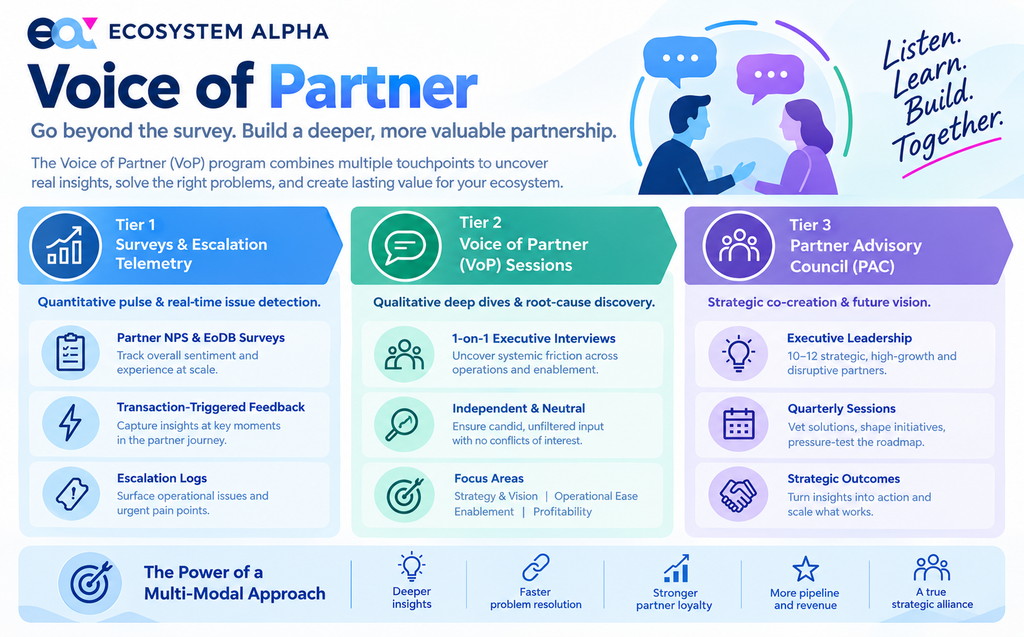
1. Voice of Partner (VoP): The Qualitative Deep Dive
Just as customer-centric teams rely on Voice of Customer (VoC) interviews rather than relying purely on CSAT scores, ecosystem leaders require dedicated Voice of Partner (VoP) sessions.
Spending structured, dedicated 1-on-1 time with a representative cohort of partner leaders consistently yields operational insights that surprise even veteran channel executives. In our work running these programs, partner leaders repeatedly say:
No other vendor takes the time to do this
Committing time to listen directly sets your program apart from the competition.
For a VoP initiative to succeed, three conditions are essential:
- Independence: Partners hesitate to be completely honest with the Partner Account Manager (PAM) who controls their margins, deal registrations, or tier status. Using an independent third party or neutral facilitator gives partners a safe space to share candid, unvarnished truths.
- Synthesis Over Finger-Pointing: Insights must be consolidated and anonymized across cohorts to spotlight systemic operational issues rather than individual personality conflicts.
- Rooted in Operations: Focus conversations around the pillars that actually drive partner viability and alignment—Strategic Fit, Operational Ease, Product Experience & Value, Program Clarity and Needs, and ultimately, alignment on Priorities.
2. The Partner Advisory Council (PAC): Your Strategic Kitchen Cabinet
Once qualitative Voice of Partner sessions surface ecosystem friction, where do you test the solutions?
A Partner Advisory Council serves as your co-creation engine. Composed of 10 to 12 executive leaders from strategic, high-growth, and disruptive partners, the PAC convenes quarterly to vet solutions before they are rolled out across the wider channel. If you are redesigning your tier incentives or launching a new product roadmap, run it by your PAC first. If they push back, the broader market will too.
The Rule of the Closed Loop: You Said, We Did
The fastest way to destroy trust in a Voice of Partner program is to ask for candid feedback, thank the partners for their time, and change nothing.
Partners willingly invest 30 to 45 minutes in a strategic conversation only when they believe their input drives measurable action. A rigorous VoP architecture requires a deliberate, disciplined loop:
We Are Doing: Commit to specific, measurable changes with accountable internal owners. Whether it is streamlining the deal registration workflow, introducing faster certification paths, or fixing integration points, show the operational follow-through.
You Said: Acknowledge the core themes, operational bottlenecks, and margin pain points partners raised.
We Heard: Reflect back your understanding of the root causes—demonstrating that you absorbed the business impact behind the frustration.
Radical Listening as a Competitive Advantage
Your partner program is never “finished.” Much like great software, it requires continuous discovery, user feedback, and iterative improvement.
When you embrace feedback as a gift—actively inviting escalations, structuring neutral qualitative Voice of Partner sessions, and governing alongside a Partner Advisory Council—you uncover the blind spots your competitors ignore.
Listening systematically transforms your organization from just another technology entry on a partner’s line card into an indispensable platform they actively want to grow with.
About Ecosystem Alpha
Ecosystem Alpha is an advisory firm that helps B2B technology and services companies build, operationalize, and scale cross-functional ecosystem strategies designed to drive revenue, retention, and go-to-market efficiency. Built on deep operational expertise in partnership strategy, the firm provides B2B organizations with the frameworks needed to integrate partner motions directly into their core business. Through tools like the Ecosystem Alpha Assessment—a structured diagnostic to evaluate partnership readiness—and industry insights shared on the Ecosystem Alpha Podcast, the firm positions partnerships not as an isolated sales channel, but as a central, company-wide growth engine.